
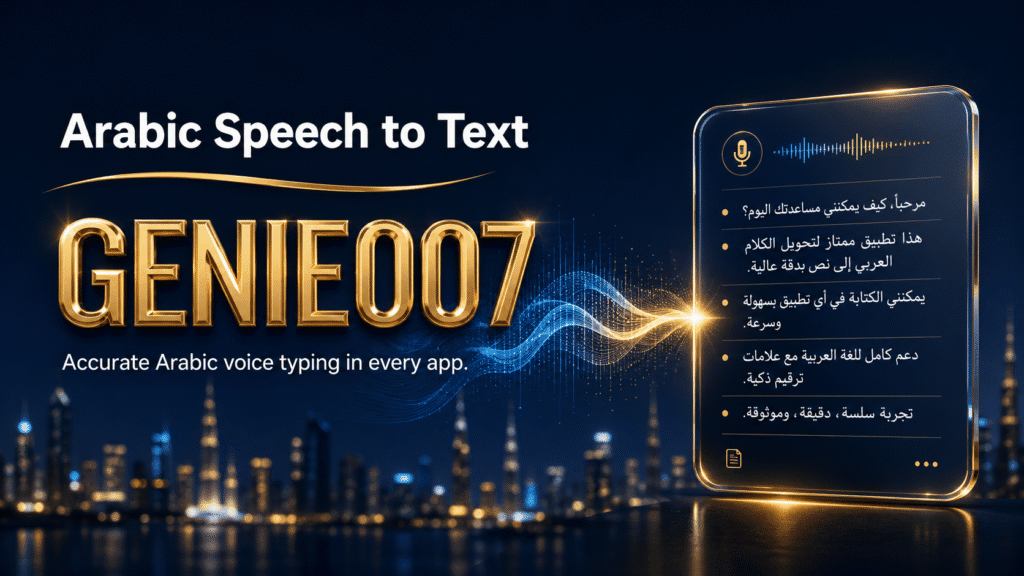
Arabic speech to text has improved sharply since 2024, but tool choice still matters: word error rates for Modern Standard Arabic sit around 8–15% on clean audio, while regional dialects like Egyptian, Gulf and Levantine Arabic can run notably higher unless the tool was actually trained on dialectal speech.
That gap — formal Arabic versus the Arabic people actually speak at home, in voice notes and on calls — is the single biggest reason Arabic dictation feels less reliable than English dictation. This guide tests the realistic options for 2026, explains right-to-left text handling and diacritics in plain terms, breaks down exactly why Egyptian, Gulf and Levantine accuracy differs from Modern Standard Arabic (MSA), and shows where live Arabic-to-English translation changes the whole equation.
Setting up dictation on your own devices first? Our arabic voice typing setup guide covers Gboard, iPhone, Windows, Mac and Google Docs before you commit to a tool.
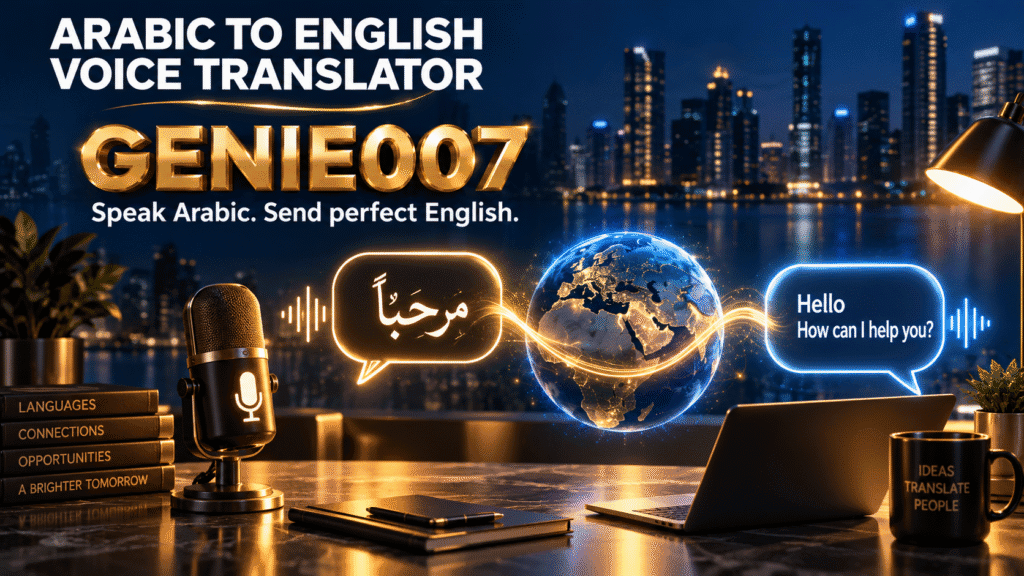
If you also need to reply in English rather than just capture Arabic, our arabic to english voice translator guide covers the live-translation workflow end to end.
Speech to Text Arabic: Why Arabic Is Harder to Recognise Than English
English voice typing has become close to invisible — it just works, quietly, in the background. Speech to text Arabic tools haven’t reached that maturity yet, for reasons rooted in the language itself rather than lazy engineering. Arabic is morphologically dense: a single three-letter root can generate dozens of related words through prefixes, suffixes and internal vowel changes, which multiplies the number of forms a model has to recognise correctly.
Diacritics compound the problem. These are the small marks above and below letters that indicate short vowels and can completely change a word’s meaning — but they’re routinely omitted in everyday digital Arabic (chat, social posts, most typed documents). A speech engine trained without exposure to diacritised text has to guess at meaning from context alone, which is exactly where dialect variation, background noise and homographs cause errors to spike. Add regional dialects that diverge from each other almost as much as from MSA, and you have a genuinely harder recognition problem than English presents.
Arabic Voice to Text: The Best Tools Tested in 2026
Three realistic categories cover most people searching for arabic voice to text tools right now: free built-in options from Google and Apple, Microsoft’s Office-integrated dictation, and specialist voice AI platforms built for multilingual, cross-application work. Each has genuine strengths worth knowing before you commit.
Google Docs Voice Typing remains free and genuinely capable for MSA. It handles right-to-left formatting natively, punctuates reasonably well, and recognises numbers, dates and email addresses in context. The catch: it only works inside Google Docs, and dialect accuracy drops off noticeably outside formal, clearly enunciated Arabic — colloquial Egyptian or Gulf speech produces far more corrections.
Apple Dictation processes speech on-device on iPhone, iPad and Mac, which means strong privacy by default and no internet dependency. It supports Arabic input across Apple’s apps, and quiet, formal speech comes through cleanly. Like Google’s tool, it favours standard pronunciation over dialect, and it’s confined to Apple’s own ecosystem rather than working everywhere you type.
Microsoft Dictate is built into Word, PowerPoint and Outlook, with proper right-to-left support and no separate installation if you already use Microsoft 365. It’s a solid default for anyone embedded in the Office ecosystem, but it shares the same ceiling as the other built-ins: transcription only, MSA-favoured accuracy, no live translation, and no reach beyond Microsoft’s own apps.
Genie 007 takes a different approach entirely. Instead of transcribing your Arabic word-for-word and leaving you to fix dialect slips and missing diacritics afterwards, Genie 007’s think-to-text technology listens for what you mean and produces finished, polished text. You’re not confined to one app — it works inside Gmail, WhatsApp, LinkedIn, Notion, Slack and dozens of others on Windows, Mac, mobile and the browser extension, without copy-pasting between a dictation tool and the app you’re actually writing in.
Free Arabic Speech to Text: What Google and Apple Actually Offer
If you’re comparing arabic speech to text free options today, there are exactly two worth taking seriously: Google Docs Voice Typing and Apple Dictation. Both are genuinely free, both handle Modern Standard Arabic competently, and both process right-to-left text without manual adjustment. Neither requires an account upgrade or hidden subscription to use the Arabic language pack.
The honest limits matter just as much as the strengths. Free arabic speech to text tools from Google and Apple are built for general-purpose dictation, not dialect-aware or workflow-aware voice AI — they transcribe what you say into the app you’re already in, nothing more. If you’re writing formal MSA inside Docs or a Mac app and don’t need cross-application reach, they’re a perfectly reasonable starting point and there’s no reason to pay for more. If you speak Egyptian, Gulf or Levantine Arabic day to day, need dictation to follow you across Gmail, WhatsApp and Slack, or want your spoken Arabic turned into polished English on the fly, free built-ins stop being enough fairly quickly.
Best WER Egyptian Arabic ASR: Dialect Accuracy Explained
Word error rate (WER) is the standard way researchers measure how good a speech engine actually is: it’s the percentage of words an engine gets wrong — substituted, dropped or wrongly inserted — when its output is checked against what a human transcriber heard. A 10% WER means roughly one word in ten needs fixing; a 25% WER turns a two-minute voice note into a genuine editing job. This is the metric behind every “best WER Egyptian Arabic ASR” comparison, and it’s worth understanding rather than treating as marketing noise.
The accuracy gap between MSA and dialectal Arabic is well documented and still holds in 2026. A November 2025 study on context-aware Arabic ASR found that while multilingual models handle Modern Standard Arabic well, “error rates rise sharply on dialectal and accented speech” — the same paper measured average relative WER reductions of over 22% on MSA against roughly 9% on dialectal Arabic even after applying context-aware correction techniques, underlining how much further behind dialect recognition still sits (arXiv, 2025). Earlier landmark research from Google’s cross-dialect Arabic voice search project measured an average 24.8% WER across five dialects — Egyptian, Jordanian, Lebanese, Saudi and Emirati — with the Levantine dialects (Jordanian, Lebanese) performing best, Egyptian sitting in the middle of the pack, and the Gulf dialects (Saudi, Emirati) trailing furthest behind (Google Research).
Egyptian Arabic specifically benefits from being one of the most widely spoken and most-represented dialects in training data — it’s the dialect most Arabic speech resources cover after MSA — which is part of why it tends to land in the middle rather than the bottom of dialect accuracy tables. Gulf Arabic (Saudi, Emirati, Qatari) and Levantine Arabic (Jordanian, Lebanese, Palestinian, Syrian) each carry distinct vocabulary, pronunciation and even grammatical patterns that a model trained mainly on MSA or Egyptian data will misread. The 2024 Casablanca project, a large-scale community effort to collect and transcribe Arabic dialect data across eight varieties including Egyptian, Emirati and Jordanian, exists specifically because “the majority of world languages and dialects remain uncovered” by existing speech datasets (Casablanca, arXiv 2024) — a gap that still shapes which dialects any given tool handles well today.
The practical takeaway: if a tool advertises “Arabic support” without specifying which variety it was trained on, assume it means MSA. Dialect accuracy is the differentiator that separates genuinely useful Arabic speech to text tools from ones that only work for formal, textbook Arabic.
Convert Voice to Text Arabic: A Step-by-Step Dictation Arabic Guide
Getting started with dictation Arabic tools takes minutes regardless of which option you choose, but the setup steps differ slightly by platform. Here’s how to convert voice to text arabic with each of the main options covered above:
- Google Docs: open a document, go to Tools > Voice Typing, click the language dropdown and select Arabic (choose your preferred variant if offered), then click the microphone icon and start speaking.
- Apple Dictation: open Settings > General > Keyboard, enable Dictation, add Arabic under Dictation Languages, then tap the microphone icon on any keyboard to dictate in any app.
- Microsoft Dictate: in Word, Outlook or PowerPoint, select Dictate from the Home ribbon, choose Arabic from the language settings gear icon, and speak — punctuation commands work the same as in English.
- Genie 007: install the app or browser extension, open the language settings and confirm Arabic (or leave it on auto-detect, since Genie 007 recognises 140+ languages by context), then use Voice Typing for direct dictation or Genie Mode to describe what you want written and let it draft the finished text.
Whichever tool you pick, a quiet environment and a normal speaking pace still make the single biggest difference to accuracy — that holds true whether you’re dictating in Arabic or English, and it matters more for dialectal Arabic than for MSA because dialect models have less training data to fall back on when audio is noisy.
Right-to-Left Text, Diacritics and Arabic-to-English Live Translation
Right-to-left script support has matured considerably since 2023. Google Docs, Microsoft Word and modern browser-based tools now handle Arabic text direction correctly by default — text flows right to left, punctuation sits where it should, and line breaks behave as expected. The rough edges show up at the boundaries: embedded Latin text (brand names, email addresses, URLs), mixed-direction sentences, and documents that switch between Arabic and English mid-paragraph. Genie 007 handles RTL formatting automatically across every application it works in, so switching between an Arabic WhatsApp message and an English email doesn’t require manual direction fixes.
Diacritics remain the harder, less-solved problem. Formal written Arabic — academic work, religious texts, some professional documentation — depends on diacritics to disambiguate words that look identical without them. Everyday messaging and most professional correspondence skip diacritics entirely, which is one reason speech recognition trained on diacritised text still struggles with casual spoken Arabic: the model has to infer intended vowels from context with no written cue at all.
This is where live translation changes the calculus rather than just working around it. Instead of transcribing your Arabic speech into Arabic text and leaving translation as a separate copy-paste step, Genie 007’s live translation understands your spoken Arabic and produces polished output directly in another language — English, French, or any of 140+ languages — inside the email, message or document you’re already working in. Speak in Egyptian or Gulf Arabic and get grammatically correct English out, or speak in Arabic and receive formal MSA instead of a literal dialect transcript. For teams working across Arabic and English day to day, or for non-native MSA speakers who think in dialect but need to write formally, that’s a meaningfully different workflow from dictate-then-translate. If you regularly work across other non-Latin or right-to-left scripts, the same live translation approach applies to Urdu voice to text and to speaking Hindi while typing out in English.
Best Arabic Speech to Text Tools Compared
Here’s how the four realistic options for arabic speech to text stack up side by side, covering the factors that actually change day-to-day accuracy and usability.
| Tool | Platforms | MSA Accuracy | Dialect Support | RTL Handling | Live Translation | Cost |
|---|---|---|---|---|---|---|
| Google Docs Voice Typing | Browser (Docs only) | Good | Fair | Yes | No | Free |
| Apple Dictation | iPhone, iPad, Mac | Good | Fair | Yes | No | Free |
| Microsoft Dictate | Windows, Mac (Office apps only) | Good | Fair | Yes | No | Free |
| Genie 007 | Windows, Mac, mobile, browser | Excellent | Strong across Egyptian, Gulf and Levantine | Yes, automatic | Yes — 140+ languages | From £5/mo |
Who Should Use Which Arabic Speech to Text Tool?
Choose Google Docs Voice Typing if you write formal Arabic inside one document type and cost is the deciding factor. It’s genuinely free, needs no installation, and handles Modern Standard Arabic reliably enough for most academic and professional writing — the trade-off is that you’re locked into Docs and dialect recognition is inconsistent.
Choose Apple Dictation if you’re already inside the Apple ecosystem and want on-device privacy with zero setup. It’s a sensible default for quick notes and messages in formal Arabic, but like the other built-ins it isn’t dialect-aware and doesn’t follow you outside Apple’s apps.
Choose Microsoft Dictate if your work lives in Word, Outlook and PowerPoint and you’d rather not add another tool. It’s free, RTL-aware and integrated — the limitation is the same as the other built-ins: transcription only, no cross-application reach, no translation.
Choose Genie 007 if you need arabic speech to text that actually understands dialect and intent rather than just transcribing phonemes. You’re paying for accuracy across Egyptian, Gulf and Levantine Arabic as well as MSA, universal application support instead of one locked-in app, live translation into 140+ languages, and think-to-text that drafts finished messages instead of handing you a raw transcript to fix. For professionals managing Arabic-English correspondence, client work across dialects, or multilingual teams, that combination is usually worth the subscription — and there’s a free trial with no credit card required if you want to test dialect accuracy on your own voice first.
Frequently Asked Questions
Does Google Docs support Arabic voice typing?
Yes. Google Docs Voice Typing supports Modern Standard Arabic with automatic punctuation and right-to-left text formatting, and it’s free to use. Accuracy is good for formal written Arabic but drops for regional dialects like Egyptian or Gulf Arabic — enable it from Tools > Voice Typing and select Arabic from the language menu.
Why is Arabic speech recognition so difficult?
Arabic’s morphological richness, its reliance on diacritics that are usually missing from everyday text, and wide dialect variation all add complexity English doesn’t have. Modern Standard Arabic word error rates typically run 8-15% on clean audio, and dialectal Arabic (Egyptian, Gulf, Levantine) runs meaningfully higher unless a model was specifically trained on that dialect’s speech data.
Can I use voice typing in Arabic with right-to-left text?
Yes, modern dictation tools handle RTL text correctly by default. Google Docs, Microsoft Word, Apple Dictation and Genie 007 all position Arabic text, punctuation and line breaks rightward as expected. The edge cases are embedded Latin text (URLs, brand names) and documents that mix Arabic and English mid-sentence.
What’s the difference between MSA and dialect speech recognition accuracy?
Modern Standard Arabic (MSA) is more standardised and better represented in training data, so it consistently outperforms colloquial dialects like Egyptian, Gulf or Levantine Arabic in word error rate. Research shows the accuracy gap is still significant in 2026: tools trained mainly on MSA transcribe formal Arabic well but misread dialectal speech, which is why dialect-specific or multilingual-adaptive tools matter for everyday spoken Arabic.
What is the best STT for Arabic?
For free, formal MSA dictation inside one app, Google Docs Voice Typing or Apple Dictation are solid choices. For accurate Egyptian, Gulf and Levantine dialect recognition across every app you use, plus live Arabic-to-English translation, Genie 007 is the stronger fit — the right answer depends on whether you need dialect accuracy and cross-app reach or just free, occasional MSA transcription.
هل يدعم جيني 007 اللغة العربية؟
نعم، يدعم جيني 007 اللغة العربية بالكامل، بما في ذلك اللهجة المصرية والخليجية والشامية إلى جانب العربية الفصحى، مع ترجمة فورية من العربية إلى أكثر من 140 لغة أخرى داخل أي تطبيق تستخدمه. (English translation: Yes, Genie 007 fully supports Arabic, including Egyptian, Gulf and Levantine dialects alongside Modern Standard Arabic, with live translation from Arabic into 140+ other languages inside any app you use.)
Try Genie 007 Free
Arabic speech to text shouldn’t mean choosing between free-but-formal-only and accurate-but-locked-to-one-app. Genie 007 handles Egyptian, Gulf and Levantine dialect alongside MSA, translates your spoken Arabic into 140+ languages on the fly, and works everywhere you already type.
Speaking English with an Arabic accent? Our voice typing accent guide shows how accurate modern dictation is for every English accent.
Download Genie 007 free — available for Windows, Mac, mobile and as a browser extension. No credit card required.
Written by Bill Kiani, founder of Genie 007.