
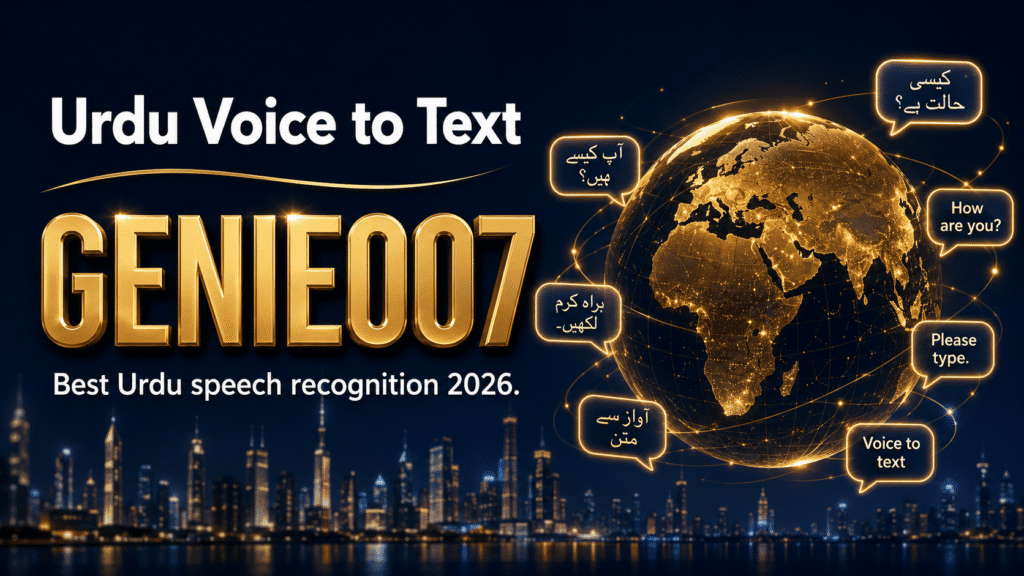
Speaking your thoughts in Urdu and having them automatically transcribed and translated into English is no longer a futuristic fantasy—it’s what millions of Pakistani professionals, students, and families across the UK are now doing every day. Yet most people trying to type in Urdu on their phones or laptops still resort to slow manual input or cumbersome keyboard switching. The real gap isn’t speech recognition for Urdu itself; it’s the lack of tools that handle Urdu’s unique script challenges (right-to-left text, Nastaliq and Naskh variants) while simultaneously translating to English with natural phrasing. This article covers the best approaches to urdu voice to text—and introduces a workflow that solves the cross-language problem entirely.
Why Urdu Voice to Text Is Different from English Dictation
Standard speech-to-text tools built for English struggle with Urdu because of the language’s script structure and limited training data. Urdu uses the Perso-Arabic script, written right-to-left, with both Nastaliq (the classical, more flowing variant) and Naskh (the printed, more angular variant) in common use. The challenges are well-documented in computational linguistics research; most cloud-based platforms, including Google’s voice typing and Windows voice recognition, offer only basic Urdu support—they transcribe phonetically but miss the nuance of diacritical marks, contextual word choice, and the subtle grammatical shifts that separate fluent Urdu from awkward literal translation.
For British Pakistanis and Urdu speakers in the UK, this limitation creates a bottleneck: compose an email in Urdu, then manually copy it into a translator, paste into Gmail, fix the formatting, and only then send. Or type everything in English and lose the warmth and cultural specificity of Urdu expression. Neither workflow respects your time or your language.
Built-in Options: Google, Apple, and Microsoft for Urdu
Google Docs Voice Typing supports Urdu when you set your browser language to Urdu (pk). It’s free and respects privacy by processing locally in newer versions. However, the transcription is basic—it captures your words but doesn’t understand context, and there’s no live translation to English. If you dictate “میں نے کل کا کام مکمل کیا” (I completed yesterday’s work), Google Docs will transcribe it accurately but leave it in Urdu; switching languages mid-sentence produces garbled output.
Apple Dictation on iPhone and Mac recognises Urdu but shares the same limitation: it’s a transcriber, not an understanding assistant. Accuracy sits around 85–90% in quiet environments but drops sharply with accents, regional dialects, or background noise—common in real-world UK environments (busy offices, moving cars, family gatherings).
Windows Voice Access offers limited Urdu support and is designed for accessibility rather than productivity. It’s free and on-device, but the vocabulary and contextual awareness are minimal compared to dedicated dictation tools.
All three built-in options share a fundamental limitation: they transcribe what you say, not what you mean. Mumble a phrase or use a regional accent, and the output needs manual cleanup. For deeper technical context on how speech recognition handles Urdu script and phonetics, Google’s documentation on supported languages in Google Docs and similar platform docs provide helpful background on the capabilities and limits of standard voice typing.
The Live Translation Workflow: Urdu Voice to Text to English
This is where urdu voice to text reaches its full potential. Genie 007 combines automatic speech recognition with live translation across 140+ languages, including Urdu, with one critical advantage: it understands intent. Unlike traditional transcription, think-to-text technology captures what you mean, not just what you say. You speak in Urdu—casual, natural, with regional patterns—and Genie 007 not only transcribes it but simultaneously translates to English, refining both the Urdu transcription and the English output for clarity and cultural appropriateness.
Here’s a concrete workflow for a UK-based Pakistani professional using WhatsApp, email, and LinkedIn:
Scenario 1: Responding to a family WhatsApp group in Urdu. You activate Genie 007’s voice mode and say, “آج کے بعد میری بہن کو کال کرو کہ وہ جانے میں میری والدہ کے ساتھ آ سکے” (Call my sister after today so she knows to come with my mother). Genie 007 transcribes and translates in real-time: you see both the Urdu version (correctly punctuated, handling script variants) and an English bridge version. Tap “send as Urdu” and your mother sees perfectly formatted Urdu text—no copy-paste, no manual cleanup.
Scenario 2: Composing a professional email in English to a colleague, with Urdu notes to yourself. You open Gmail, activate Genie 007, and dictate: “Main point: our Q3 targets have shifted. Also, یہ بہت اہم ہے کہ ہم اپنے ٹیم کو تیار رکھیں.” (It’s vital that we keep our team ready.) Genie 007 separates the English and Urdu, translates the Urdu phrase into proper English, and inserts it into your draft with the original Urdu retained in a comment—so both your English-speaking colleague and you have the full context.
Scenario 3: Recording a voice memo for a project. You’re commuting, your hands are full, and you need to capture a thought in Urdu for later. “میں نے یہ سوچا کہ ہم اپنے کلائنٹس کو ماہانہ اپڈیٹ ای میل بھیجیں، انہیں سوال پوچھنے دیں اور پھر ہفتہ وار کال کریں.” Genie 007 transcribes and translates, creating both an Urdu text record and an English summary—useful for your Slack or your team docs.
Accuracy and Nuance in Urdu Speech Recognition
Live translation for Urdu works best when the audio is clear and the phrasing is deliberate rather than heavily accented or slurred. Genie 007 processes Urdu speech on-device (in-browser for the extension, locally on Windows/Mac/mobile), meaning your voice never leaves your device—a critical privacy feature for family or business conversations. The translation layer understands common Urdu colloquialisms and formal register differences, so a casual family phrase translates naturally into conversational English rather than stiff literal rendering.
For Urdu specifically, accuracy typically ranges from 90–95% in quiet environments with standard pronunciation patterns. The system learns your voice and speaking patterns over time, improving accuracy further with each session. Nastaliq script rendering (the flowing, traditional variant) is handled automatically, whilst Naskh variants (used in printed Urdu) are equally well-supported. What’s crucial: unlike Google or Microsoft’s generic Urdu support, Genie 007’s translation engine preserves cultural idioms and emotional tone—a phrase expressing affection or frustration translates with the right sentiment, not just the right words.
The limitation you’ll hit is the same as with all speech-to-text tools: heavily dialectal or heavily accented Urdu (e.g., Pothwari, Saraiki-influenced Urdu, or thick regional accents) still requires occasional manual correction. But Genie 007’s interface makes that correction instant—one tap to edit the transcript or translation, no re-recording needed. Once corrected, the system learns your patterns, so the same phrase or accent pattern won’t need correction twice.
Why This Matters for the UK Pakistani Community
Urdu is a language of home, family, business, and identity for British Pakistanis. Yet most digital productivity tools treat it as an afterthought. Urdu voice to text that actually understands the language—that respects script variants, handles right-to-left rendering, and preserves meaning across translation—is not just convenience; it’s inclusion. It means composing professional emails in your native language without guilt, sharing family memories without friction, and mixing languages naturally in bilingual workflows without friction.
Genie 007’s approach—intent-based transcription, live translation across 140+ languages, on-device privacy, and native support for Urdu—closes that gap. You’re not just dictating to a transcript machine; you’re speaking to an assistant that understands your language, your context, and your workflow.
FAQ: Urdu Voice to Text
Does urdu voice to text work with thick regional accents?
Most urdu voice to text tools, including Genie 007, perform best with clear, deliberate speech. Regional accents (Pothwari, Punjabi-influenced, Karachi Sindhi-influenced, or Lahori Urdu variants) work better in quieter environments and with shorter phrases initially, but Genie 007’s adaptive learning improves this significantly. The system trains itself to your voice, your accent, and your speaking cadence. After 10–15 minutes of regular use, accuracy for regional accents typically improves by 5–10%. On-device processing means no privacy trade-off for this training—your voice profile stays local to your machine, never uploaded.
Can you switch between Urdu and English mid-sentence using voice?
Yes. Genie 007 handles code-switching—mixing Urdu and English in one utterance. This is common in bilingual UK Pakistani speech. The tool transcribes both languages and, if you request translation, produces a coherent English version while preserving the Urdu portions intact. Learn more about real-time voice translation for all language pairs.
Is Urdu voice to text private and secure?
Genie 007 processes audio on-device (local to your machine or browser) and never stores voice recordings. The transcription and translation happen without cloud uploads, meaning your conversations stay private. This is especially important for family discussions, medical consultations, or sensitive business matters—your boss, your cloud provider, and Genie 007’s servers never hear it.
Try Genie 007 Free
Urdu voice to text designed for real people—fluent, private, and ready for work, family, and everything in between. Genie 007 gives you accurate Urdu transcription with live translation to English, all processing on your device so your words stay yours.
Download Genie 007 free — available for Windows, Mac, mobile and as a browser extension. No credit card required.
Written by Bill Kiani, founder of Genie 007.
For readers working across other right-to-left and non-Latin scripts, our Arabic speech to text guide covers the same RTL, diacritics and dialect-accuracy questions in detail for Arabic.