
Dictation for therapists means speaking your session notes instead of typing them, then getting clean, structured text back in seconds. With Genie 007 you can dictate SOAP or DAP progress notes on Windows, Mac, mobile or in your browser, with no spoken punctuation. It is free to try, with no card needed.
Notes are the part of the job nobody trained you to enjoy. A survey of 499 therapists found almost a quarter (22%) took ten minutes or more per progress note, which works out at roughly two and a half hours a week for a caseload of 18 clients. That is a lot of unpaid evening time for something that should take a few minutes.
Why Therapists Need a Faster Way to Write Notes
Typing notes is slow, but the real cost is attention. During a session, typing breaks rapport. After a session, you are trying to reconstruct what mattered while the next client is already in the waiting room. By the end of the day, the notes pile up and recall fades.
The administrative load is a known pressure point across the profession. In the American Psychological Association 2024 Practitioner Pulse Survey, 62% of psychologists who left or never joined insurance networks cited administrative challenges such as pre-authorisation requirements and audits. Paperwork is not the only reason clinicians burn out, but it is one you can shrink.
You already talk through cases in supervision and when you reflect after a hard session. Dictation for therapists simply lets that thinking land directly in the record, so dictating progress notes feels like a natural extension of how you already think.
Voice Notes for Therapists: What Actually Works
Voice notes for therapists fail when the tool only transcribes. A literal transcript includes every pause, restart and “um”, so you trade typing time for editing time. The notes still need shaping into a clinical format, and that is where the minutes go.
Good voice notes for therapists work the other way round. You say the clinical content in short fragments, and the software returns a tidy paragraph in your usual professional tone. That is the idea behind think-to-text: it delivers what you mean, not a word-for-word recording of how you said it.
If you already record audio memos on your phone, our guide to turning voice notes into text covers the basics. For clinical work, live dictation into your notes field is usually faster, because there is no audio file sitting on your device waiting to be processed and deleted.
Search for therapist dictation software and you will find tools built for full transcription of sessions. Dictation is different. You speak your own summary after the session, so you decide what goes into the record and what stays out. Many clinicians prefer that control.
Step-by-Step: Therapy Notes by Voice
Here is a simple workflow for therapy notes by voice. It takes about the same time as making a cup of tea.
- Open your notes field. Click into the progress note in your practice software, a document, or a plain text app.
- Start dictating. Press the Genie 007 shortcut and speak in short, clear thoughts. Say what happened, not how to format it.
- Follow your template. Speak the headings in order, one section at a time.
- Read and adjust. Skim the result, change anything that does not sound like you, and save.
- Do it straight away. Notes dictated within minutes of the session are more accurate than notes written that evening.
Dictating SOAP Notes
SOAP notes have four sections: Subjective, Objective, Assessment and Plan, as Headway explains in its SOAP versus DAP guide. When dictating SOAP notes, say each heading and then speak the content in fragments.
For example: “Subjective, client reports poor sleep this week, worry about work review. Objective, flat affect early on, brighter when discussing weekend plans. Assessment, anxiety symptoms consistent with previous sessions, sleep hygiene not yet in place. Plan, introduce a wind-down routine, review next week.” Genie 007 returns it as readable prose under each heading.
Dictating DAP Notes
DAP notes use three sections: Data, Assessment and Plan. Many therapists find them quicker because observation and client report sit together. When dictating DAP notes, keep Data to what you saw and heard, put your clinical interpretation in Assessment, and keep Plan to next steps.
The same approach works for BIRP notes, intake summaries and treatment plan reviews. If your practice has a preferred template, dictate its headings in the same order every time and the output stays consistent from client to client.
A Quick Before and After
Say you dictate this: “Client attended, mood low, talked about the argument with her sister, we used a thought record, she found it useful, homework is to repeat it twice this week.” Rather than a raw transcript, you get a short, professional entry that reads naturally. You check it, and it goes in the file.
Compared with a ten-minute typed note, many clinicians find dictated notes take a fraction of the time once they are used to the rhythm. Headway suggests planning five to seven minutes per progress note. Dictation is one of the easiest ways to stay inside that window.
Privacy and Compliance: Read This Before You Dictate
Session content is sensitive, so privacy comes first. Genie 007 is designed with privacy in mind and is HIPAA ready. Processing happens in your browser or on your device, audio is not stored, and your content is not logged or retained. Encryption uses AES-256, and the approach is GDPR compliant.
To be clear, “HIPAA ready” is not a certification, and no dictation tool can make your practice compliant on its own. Compliance depends on how your whole practice handles records. Our overview of HIPAA-compliant dictation software explains what to look for, and the guide to GDPR-compliant dictation covers the UK and EU side.
Practical rules we suggest to every clinician:
- Follow your own practice compliance policy and your professional body guidance first.
- If your policy forbids dictating identifiable client data, do not dictate names, dates of birth or contact details. Use initials or a client code instead.
- Keep the finished note in your approved record system, not in a loose document on your desktop.
- Ask your supervisor or data protection lead if you are unsure.
Genie 007 is a writing tool, not a clinical record system. It sits on top of the software you already use. For wider healthcare context, see medical dictation software.
Windows, Mac, Mobile and Browser
You are not tied to one device. Genie 007 runs as a Windows app, a Mac app, a mobile app and a browser extension, so the same voice typing follows you from the office to a home desk to a phone between appointments.
It works inside the tools you already have open: Gmail, Outlook, Google Docs, Notion, Teams, Zoom and most web-based practice software. There is no copy and paste and no tab switching. Click into the field, speak, and the text appears where the cursor is.
If your practice software runs in a browser, the browser extension is the quickest way to start. If you write notes in a desktop document, the Windows or Mac app covers it. Mobile is handy for a quick reflection on the way home, as long as you follow your policy on where notes may be stored.
Multilingual Therapists and 140+ Languages
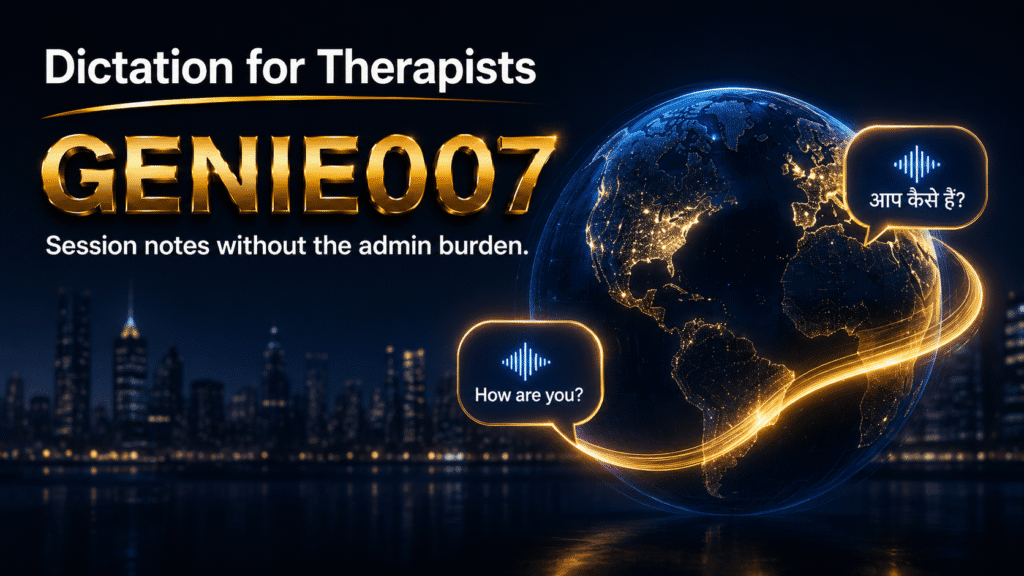
Many clinicians work in more than one language. Genie 007 supports 140+ languages, understands accents and lets you speak in one language and write in another. That means you can dictate a session summary in your first language and get the record in English, or the reverse.
This is useful for bilingual practices, interpreter-supported work and clinicians who think more fluently in a language other than the one their records are written in. Check the output carefully, especially for clinical terms, and confirm your practice allows notes in the chosen language. See dictation software for bilingual professionals for more.
Tips for Better Dictated Notes
- Speak in short thoughts. One idea at a time gives cleaner output than long, winding sentences.
- Say the headings. “Assessment” and “Plan” help structure the note.
- Use a decent microphone. A headset or good laptop microphone in a quiet room makes a real difference.
- Dictate straight after the session. Your recall is at its best.
- Keep clinical terms consistent. Use the same wording each time and the output will match your style.
- Always review before saving. You remain responsible for the accuracy of the record.
Colleagues in adjacent roles face the same pile of notes. See how it works for social workers and coaches.
Frequently Asked Questions
Can therapists use dictation for session notes?
Yes, therapists can use dictation for session notes, provided it fits their practice policy on client data. Speak a short summary after the session, review the text, and save it in your approved record system. Avoid dictating identifiable details if your policy does not allow it.
What is the difference between SOAP and DAP notes?
SOAP notes have four sections, Subjective, Objective, Assessment and Plan, while DAP notes have three: Data, Assessment and Plan. DAP combines what the client says and what you observe into one Data section. Both formats work well with dictation if you speak the headings in order.
Is voice dictation HIPAA compliant for therapists?
No dictation tool is HIPAA certified by default, because compliance depends on how your practice handles records. Genie 007 is HIPAA ready and designed with privacy in mind, with on-device or in-browser processing and no stored audio. Always follow your own practice compliance policy.
How long should a therapy progress note take?
A progress note should usually take about five to ten minutes, and sometimes up to fifteen for complex cases. One survey of 499 therapists found 22% spent ten minutes or more per note. Dictating straight after the session can bring that time down considerably.
Can I dictate therapy notes in another language?
Yes, Genie 007 supports 140+ languages and can turn speech in one language into written text in another. This suits bilingual clinicians. Review clinical terms carefully, and check that your practice allows records in the language you choose.
This article is for general information only and is not medical advice. If you are experiencing pain or other symptoms, please consult a qualified healthcare professional. It is also not legal or compliance advice: follow your own practice policy and professional body guidance on client records.
Try Genie 007 Free
Start with one note today. Dictate your next SOAP or DAP entry, see how much time you get back, and decide from there. It is free to try, with no credit card required, and paid plans are listed on the Genie 007 pricing page if you want more later.
Start your free trial of Genie 007
Written by Bill Kiani, founder of Genie 007.