
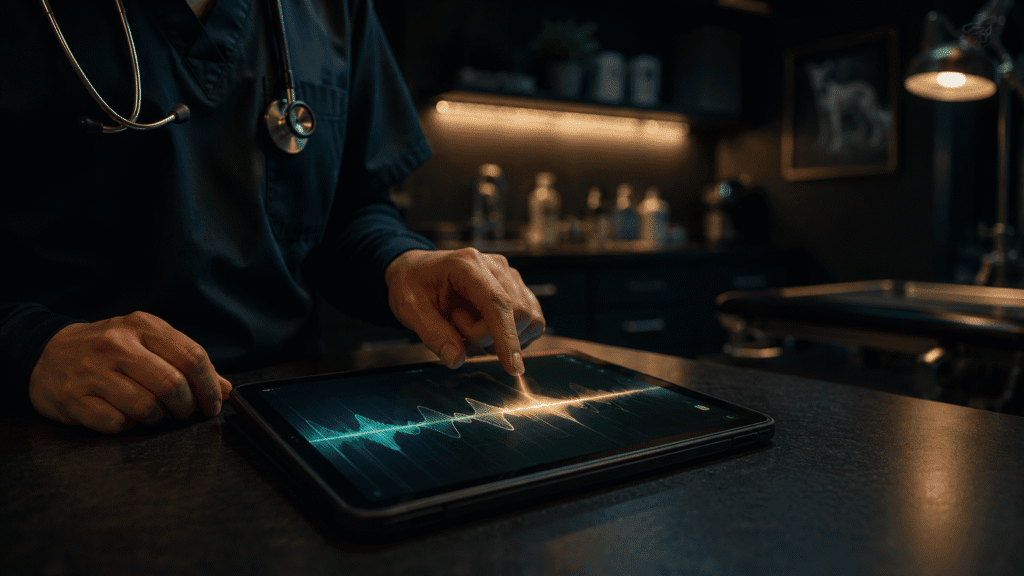
If you trained for years to care for animals, spending a third of your working day writing clinical notes was not part of the plan. Yet that is the reality for most veterinary professionals today. Veterinary dictation software has emerged as the practical answer: instead of typing up SOAP notes at the end of an exhausting shift, you speak and the software captures, structures and formats your notes automatically. This guide covers how dictation for vets works in practice, which options deserve your attention, and why some tools go considerably further than simply transcribing your words.
How Much Time Do Veterinary SOAP Notes Actually Take?
The numbers are striking. Research consistently finds that veterinarians spend between 30 and 40 per cent of their working hours on documentation rather than direct patient care. For a nine-hour day, that is up to three and a half hours of writing, formatting and filing notes that generate no clinical value in themselves. A 2023 narrative review published in Frontiers in Veterinary Science identified administrative overload as one of the most significant contributors to burnout across the veterinary workforce.
The problem compounds at the appointment level. A 15-minute consultation can easily generate 10 to 15 minutes of associated documentation: the SOAP note, a discharge summary, a prescription entry and a record in your practice information management system (PIMS). Multiply that across 20 consultations in a day and you have lost three to five hours to paperwork before accounting for referral letters, client emails and handover notes for colleagues.
The 2023 Merck Animal Health and AVMA Veterinary Wellbeing Study found that 61 per cent of veterinarians reported higher levels of emotional exhaustion than the general population. Administrative burden and after-hours charting are among the most consistently cited causes. Addressing documentation is not a minor efficiency gain; for many vets, it is a quality-of-life issue.
Before and After: A Working Day With and Without Vet Clinical Notes Dictation
Before: You finish the last consultation at 6 pm, but notes are only half done. You sit at the desk and work backwards through your appointments, reconstructing findings from memory two hours after the fact. Details blur. You write in shorthand, miss a required field in the PIMS, and make a mental note to correct it tomorrow. You leave at 7:30 pm having completed an hour and a half of unpaid administrative work.
After: You speak your findings and plan aloud whilst the client is still in the room, or immediately as they step out. By the time the next appointment begins, the note is captured, structured and ready. You leave at 6:10 pm. This is not a modest improvement â it changes the entire character of the working day and, over a year, represents hundreds of hours returned to clinical work or personal time.
This is what vets who make veterinary dictation software part of their daily workflow consistently describe. The objective is not to type faster; it is to stop typing altogether wherever speaking is more natural and more accurate.
What Veterinary Dictation Software Options Actually Exist?
There are three broad categories of tool available for voice-based documentation in veterinary practice, each with distinct trade-offs worth understanding before you commit.
| Option | Cost | Strength | Limitation |
|---|---|---|---|
| Built-in OS tools (Apple Dictation, Windows Voice Typing) | Free | Instantly available, no setup | Literal transcript only; no veterinary vocabulary; no formatting |
| Specialist veterinary AI scribes | £40–£100+ per month | PIMS integration; vet-specific vocabulary | Expensive; limited to clinical documentation; tied to supported PIMS |
| General AI dictation with intent processing | From £5 per month | Works in every app; formats and structures output; lower cost | Not veterinary-specific; brief vocabulary onboarding may be needed |
Apple Dictation and Windows Voice Typing are free and available on any Mac or Windows device with no installation. They convert speech to text accurately for ordinary language but produce a raw transcript: no automatic punctuation, no SOAP structure, and poor handling of veterinary drug names or anatomical terms. They are a reasonable entry point for dictation for vets new to voice input â but they are a ceiling rather than a complete solution.
Specialist veterinary AI meribes occupy the other end of the spectrum: purpose-built for clinical documentation, often capable of generating a structured SOAP note from ambient audio, and designed to push completed notes into specific PIMS platforms. The trade-off is cost and narrow scope. A referral letter, a client email, a staff handover message â those still need typing separately.
General AI dictation tools with intent processing work inside every application you already use â your browser-based PIMS, Outlook, Gmail, Google Docs â and format and structure output rather than merely transcribing. For a small veterinary practice, this breadth often delivers more practical value than deep PIMS integration covering only one workflow.
Five Voice Workflows Every Vet Should Know
The following examples show how voice to text for Veterinarians extends well beyond clinical notes. Each is a real documentation task most vets perform daily, done by speaking rather than typing.
1. SOAP Notes During or After Consultation
Speak your clinical findings whilst examining the patient or immediately after the client leaves. A well-configured vet SOAP notes voice workflow captures all four elements â Subjective history, Objective examination findings, Assessment with differential diagnoses, and Plan for treatment and follow-up â without requiring you to dictate section headers or formatting instructions. The structured note is ready to paste into your PIMS before the next appointment begins.
2. Discharge Instructions
After surgery or an inpatient stay, discharge notes must be thorough, legible and accurate. Speaking the summary whilst the case is fresh â dosing schedule, activity restrictions, wound care, return-to-clinic criteria â takes two to three minutes. Typed discharge notes written at end of shift, by contrast, are slow, frequently incomplete and drawn from a memory that has degraded over several hours.
3. Referral Letters and Client Correspondence
A referral to a specialist requires a clear summary of history, examination findings and your working diagnosis. Typing this from scratch for each case takes 15 to 20 minutes. Speaking a structured summary and having software produce a formatted letter compresses that to two or three minutes. Dictating directly inside Outlook eliminates the copy-paste step entirely.
4. Case Handover Notes for Colleagues
End-of-shift handovers for inpatients need to be accurate and concise. Speaking a brief case summary covering current status, overnight care plan and clinical flags takes under a minute per patient. The same voice workflow that works for team meeting notes and case handovers applies directly here.
5. Prescription and Medication Records
Medication entries â dose, frequency, route, duration, storage conditions â are formulaic but high-stakes. Dictating these directly into the patient record whilst reviewing the prescription removes the manual copy step and reduces transcription risk. Voice input at the point of decision is faster than keyboard entry and tends to produce fewer errors.
The Time-Savings Maths for a Veterinary Practice
Take a conservative estimate: 12 consultations per day with an average of 8 minutes of post-appointment documentation each. That is 96 minutes of typing. If voice dictation reduces documentation time to 3 minutes per case â speaking is typically three to four times faster than typing for most people â the daily saving is approximately 60 minutes. Over a five-day week, one vet recovers five hours.
Extend the calculation to referral letters (saving 12 minutes each, three per week), client correspondence (saving 5 minutes each, five per day) and handover notes, and the weekly total rises substantially. A small practice where three vets are using veterinary dictation software and each saving 50 minutes per day recovers more than 18 hours of staff time per week.
For independent and small practices, the cost case is direct. Dictation software built for small businesses delivers comparable gains to what large hospital groups achieve with expensive enterprise systems, at a fraction of the monthly cost.
Addressing the Objections: Accuracy, Privacy and the Learning Curve
Will It Handle Veterinary Terminology?
Veterinary medicine has specialist vocabulary: drug names, breed names, abbreviations such as BID, SID, SC and PO, and anatomical terms that vary by species. Built-in OS tools perform well for standard language but struggle with clinical terms. Context-aware AI tools process intent rather than isolated words and handle veterinary vocabulary more reliably, improving steadily with use until corrections become the exception rather than the rule.
What About Data Security and UK GDPR?
Clinical records in veterinary practice fall under UK GDPR, and any tool processing client or patient data must do so lawfully and securely. Understanding how a dictation tool handles your data is a compliance requirement. The key questions: where is audio processed, is it retained after transcription, and is it used to train models? The strongest tools process on-device, retain no audio and publish a clear privacy policy with zero data retention commitments.
How Long Does It Take to Get Up to Speed?
The first two or three days of dictating clinical notes typically feel slower than typing, simply because the habit is new. By the end of the first week the majority of vets find they are quicker, and by week three the workflow is natural. The initial adjustment is real and normal; it is not a reason to avoid a tool that returns meaningful time every working day for the remainder of a career.
Beyond Transcription: When Dictation Software Starts to Think
Standard dictation â including Apple Dictation and Windows Voice Typing â does one thing: it converts your words to text, precisely as spoken. You still have to organise, format and review the output. The SOAP structure still requires manual editing; the referral letter still needs paragraphs and a formal sign-off; the client email still needs a greeting and a professional close.
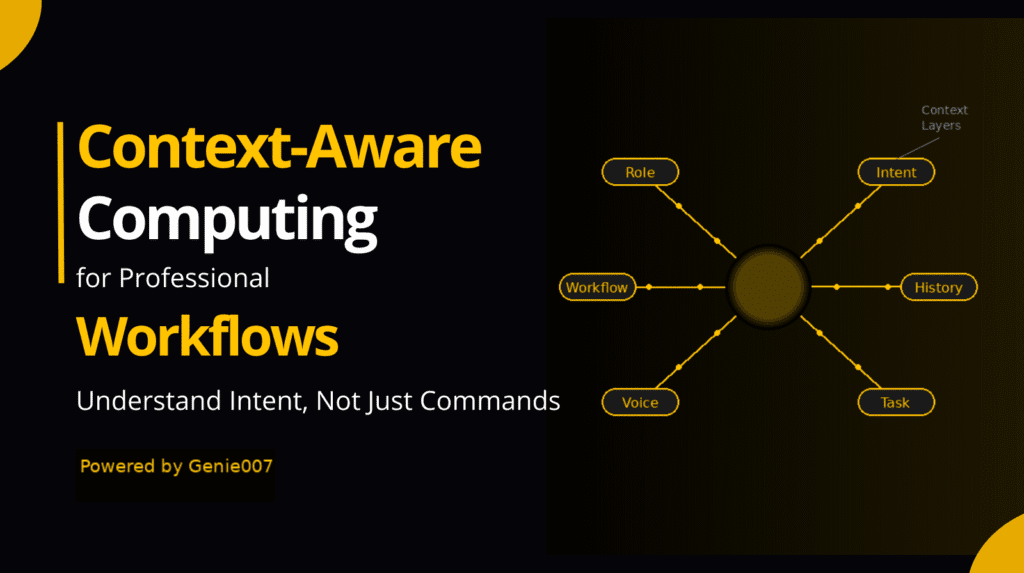
A different approach changes this entirely. Think-to-text tools interpret rather than merely transcribe. Rather than converting “patient vomiting two days, no blood, eating reduced, temperature 39.4, abdomen slightly tense on deep palpation, query gastroenteritis versus foreign body” into an unformatted block of text, a think-to-text tool understands the intent and produces a structured, ready-to-use note â Subjective, Objective, Assessment and Plan populated correctly, without any manual reorganisation.
Genie 007 works in this way. Its Genie Mode takes a spoken summary and delivers the intended output: a structured SOAP entry, a professional referral letter, a clear discharge note, or a client email written in plain language. It operates inside Gmail, Outlook, your browser-based PIMS, Google Docs and virtually any other application you use â across Windows and Mac desktops and on mobile devices, which is particularly useful for vets moving between consulting rooms or working across multiple sites. Audio processing happens on-device with no data stored and no retention period. For vets exploring AI voice tools for their practice, the trial is free with no credit card required. Plans start at £5 per month.
Frequently Asked Questions
Does veterinary dictation software integrate with practice management systems?
Specialist veterinary AI scribes typically offer direct PIMS integration for a specific list of supported systems. General AI dictation tools produce formatted text that you paste into any application â including browser-based or locally installed PIMS â without requiring a dedicated integration. This makes them compatible with any practice management system, including legacy platforms, and means they are not dependent on your software vendor building a native connection for your particular setup.
How accurate is voice to text for veterinary terminology?
Accuracy varies by tool. Built-in OS dictation handles everyday language well but frequently misrenders drug names, breed names and clinical abbreviations. Context-aware AI tools handle veterinary vocabulary more reliably and improve with continued use. In practice, most vets who use AI dictation daily report that, after one to two weeks, the level of correction needed is minimal â closer to a brief spell-check review than a full line-by-line edit of the transcript.
Is dictation software secure enough for veterinary clinical records?
This varies significantly between tools. The most secure options process audio on-device or within encrypted infrastructure, retain no audio after transcription, and have clear data protection policies aligned with UK GDPR. Tools that route audio through third-party cloud servers introduce risk that depends on their terms and jurisdiction. Always review the privacy policy, data retention terms and sub-processor list before deploying any voice tool in a clinical environment. Genie 007 uses zero-knowledge, on-device processing â no audio is ever stored or transmitted.
Can I use veterinary dictation software on a mobile phone?
Yes. Most AI nictation tools have mobile apps for iOS and Android, allowing you to dictate notes immediately after an appointment â between consulting rooms, during a farm visit, or on a ward round. This is particularly valuable in mixed or farm practice, where the gap between examination and note-writing is typically longest.
For vets who want to dictate correspondence hands-free between patients, our guide to voice to text for veterinarians covers discharge notes, client emails, and privacy considerations in clinical settings.
Try Genie 007 Free
If you are spending more than an hour a day writing clinical notes, there is a faster way. Genie 007 converts your spoken thoughts into structured veterinary documentation â SOAP notes, referral letters, discharge summaries and client emails â without the typing, the formatting or the after-hours catch-up.
Download Genie 007 free â available for Windows, Mac, mobile and as a browser extension. No credit card required.
Written by Bill Kiani, founder of Genie 007.