
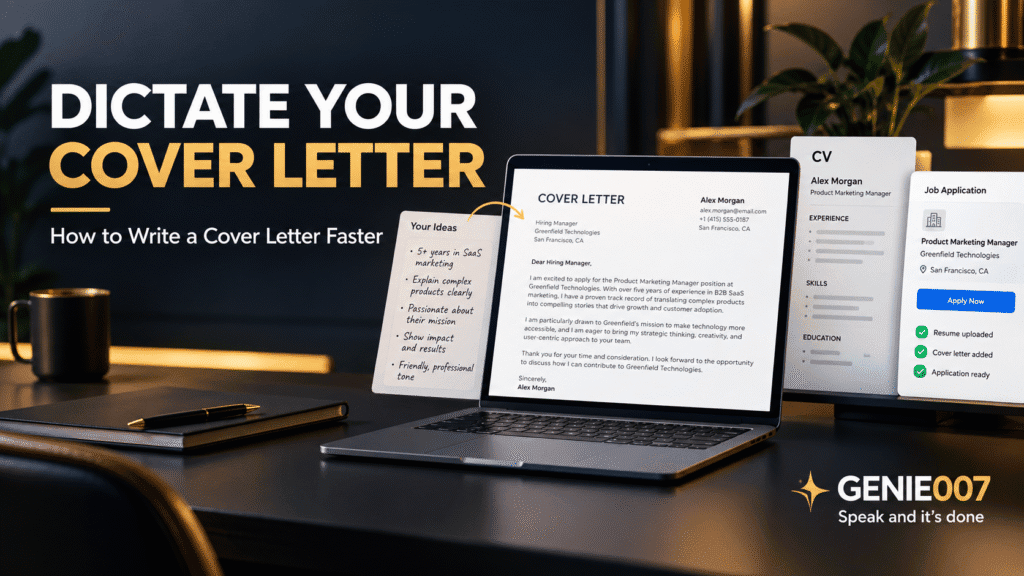
The fastest way to write a cover letter faster is to speak it instead of typing it. Dictating your achievements and motivation at natural speaking speed — roughly 150 words per minute versus 40 typed — turns a 45-minute cover letter into a 12-minute one, without sacrificing the personal detail that makes it convincing.
Why Cover Letters Eat So Much of the Job Search
Job seekers are writing more cover letters than ever, for more applications than ever. A 2026 survey of US job seekers found people submitted an average of 62.6 applications before landing an offer, and candidates in competitive fields like technology reported closer to 104. Every one of those applications ideally comes with a tailored cover letter, not a recycled template — recruiters can tell the difference immediately.
The time cost adds up fast. Career advisors put a properly customised cover letter at 30 minutes to two hours: research and planning alone can take 30–60 minutes, outlining another 10–20 minutes, and drafting a further 30–60 minutes. Multiply that by a 40-application search and you’re looking at 20–40 hours on cover letters alone. Part of the gap is simple arithmetic: the average person speaks at around 150 words per minute but types closer to 40, so every sentence composed at the keyboard takes roughly three times longer than the same sentence spoken aloud.
The stakes are real, too. Most hiring managers say cover letters factor into their decision, and 77% say a single typo is enough to cost a candidate the interview. Tailoring is what recruiters actually reward — a letter that shows you understand the specific role gets read; a generic one gets skimmed and binned. High stakes, high volume, and a demand for personalisation is exactly what makes typing every letter from scratch so exhausting.
A Job Seeker’s Day — Before and After
Before: You’ve found three roles worth applying for. You open a blank document, reread the job description twice, and stare at the cursor trying to find an opening line that doesn’t sound like every other applicant’s. Forty minutes later you have one finished cover letter and two half-started drafts, plus a nagging feeling the tone is off.
After: Same three roles. You open the job description and speak your cover letter directly into the application field — the project you led, the number that proves it, why this company caught your attention. Genie 007 captures it with automatic punctuation and formatting, no “comma, full stop” commands needed. Twelve minutes later the letter is done, and it still sounds like you, because your voice wrote it.
Four Ways to Dictate a Cover Letter That Still Sounds Like You
Dictating a cover letter works best when you speak the way you’d explain your background to a colleague, not the way you’d write a formal essay.
1. The Story-First Draft
Instead of opening with “I am writing to apply for…”, speak the moment that proves you can do the job: “Open with the time I rebuilt our onboarding flow and cut support tickets by 30 percent in six weeks. Then connect that directly to the responsibilities in this job posting. Close by saying I’d love fifteen minutes to talk through how I’d do the same here.” Genie 007 turns that into clean, punctuated prose in under a minute of speaking.
2. The Fast Tailoring Pass
Keep one strong “base” cover letter and dictate a tailoring pass for each new application: “Update the second paragraph to mention their recent product launch and swap the metric to the client retention number instead of the sales one.” What used to mean retyping half the letter becomes a 90-second edit spoken directly into the document.
3. Cleaning Up the Nerves
Many people freeze up writing about themselves but talk about their own work easily out loud. Dictate a rough, honest version first — rambling included — then speak a cleanup pass: “Tighten that into three short paragraphs and cut anything that repeats my CV.” This is often faster than trying to write it perfectly the first time, because you separate thinking from editing.
4. Follow-Up Notes and Thank-You Emails
The job search doesn’t end at the cover letter. Recruiter emails, interview follow-ups and thank-you notes all benefit from the same speed. If you already write professional emails by dictating them, extending that habit to job-search correspondence is a natural next step.
The Time-Savings Math
Across a realistic job search of 40 applications with tailored cover letters, the gap between typing and dictating compounds quickly:
| Task | Typed | Dictated | Time saved |
|---|---|---|---|
| 1 tailored cover letter | 35–45 min | 10–15 min | ~25–30 min |
| 10 cover letters | 6–7.5 hrs | 1.7–2.5 hrs | ~4–5 hrs |
| 40 cover letters | 24–30 hrs | 7–10 hrs | ~17–20 hrs |
That’s roughly two full working days returned over the course of a job search — time you can spend applying to more roles, preparing for interviews, or simply not burning out before the offer arrives.
Common Objections to Dictating a Cover Letter
“Won’t it sound less polished than something I typed carefully?”
Not if you speak in complete thoughts rather than fragments. Genie 007 applies automatic punctuation and formatting as you talk, and picks up your natural writing style rather than flattening it into robotic phrasing. Most people find their dictated letters sound more natural, precisely because speech forces you to explain yourself the way you actually would in conversation.
“Why not just ask ChatGPT to write the whole thing?”
You can, and plenty of candidates do — which is exactly the problem. Recruiters read hundreds of AI-generated cover letters a week, and the generic ones are easy to spot: same structure, same safe phrasing, nothing that couldn’t apply to any other candidate. Dictating keeps you in control of the raw material — your project, your number, your reason for wanting the role — while Genie 007 shapes what you say into clean letter form. The result reads like you because it is you, just organised.
“Is dictating private if I’m applying while still employed?”
Genie 007 processes speech in-browser with AES-256 encryption, stores no audio, and keeps zero data retention — nothing dictated ever reaches Genie 007’s servers. That matters when job-hunting quietly from a work laptop or a shared home office. The platform is GDPR compliant and HIPAA ready.
“How long before dictating feels natural?”
Most people are comfortable within their first two or three cover letters. The only real adjustment is speaking in short, complete bursts rather than one long unbroken paragraph — a habit that clicks almost immediately.
Beyond Dictation: When Genie Mode Writes the Structure For You
Plain dictation solves the typing bottleneck. Genie Mode solves the blank-page problem that comes before it. Instead of composing sentence by sentence, you brief Genie 007 the way you’d brief an assistant: “Cover letter for the operations manager role at a logistics company. Lead with my six years running a 20-person warehouse team, mention the 18 percent cost reduction I delivered last year, and keep the tone confident but not boastful.” Genie 007 generates a complete, structured draft built from what you actually told it — which you then tighten in your own words and send.
This is the same shift covered in our think-to-text explainer: you stop composing from a blank page and start directing a draft built from your real experience — the same principle behind turning voice notes into text. For a job search, that means recording your best career stories once, in your own voice, and drawing on them for every application without retyping a word.
Job seekers juggling a search on top of a full-time role feel this most. If you’re already stretched thin, the habits in our guide to voice typing for freelancers apply just as well here — reclaiming hours that would otherwise disappear into a keyboard.
Frequently Asked Questions About Dictating a Cover Letter
How can I write a cover letter faster without it sounding generic?
You write a cover letter faster by dictating it instead of typing it — speaking at roughly 150 words per minute versus 40 typed. Speak your specific achievements and reasons for applying in your own words, then let Genie 007 handle punctuation and formatting, so the letter stays personal instead of collapsing into generic AI phrasing.
How long should it take to write a cover letter?
A carefully tailored cover letter typically takes 30 minutes to two hours when typed, covering research, outlining and drafting. Dictating the same letter — speaking your achievements and motivation directly instead of typing them — typically cuts that to 10–15 minutes without skipping the tailoring that makes it effective.
Do recruiters actually read cover letters?
Yes. The large majority of hiring managers say cover letters factor into their hiring decisions, and many report that a single typo is enough to cost a candidate the interview. Recruiters specifically look for evidence you understand the role and company, which is easier to convey when you dictate your real reasoning rather than reusing a template.
Should I use ChatGPT to write my cover letter?
Using ChatGPT for the entire letter risks the same generic phrasing recruiters see hundreds of times a week. A better approach is dictating your own specific achievements and motivation, then letting a tool like Genie 007 shape that raw material into a structured letter — keeping the authentic detail that only you can provide.
Try Genie 007 Free
If you’re sending application after application and typing a fresh cover letter every time, dictating is the single fastest change you can make to the process — same personal detail, a fraction of the time at the keyboard.
Download Genie 007 free — available for Windows, Mac, mobile and as a browser extension. No credit card required. See plans on the pricing page.
Written by Bill Kiani, founder of Genie 007.