
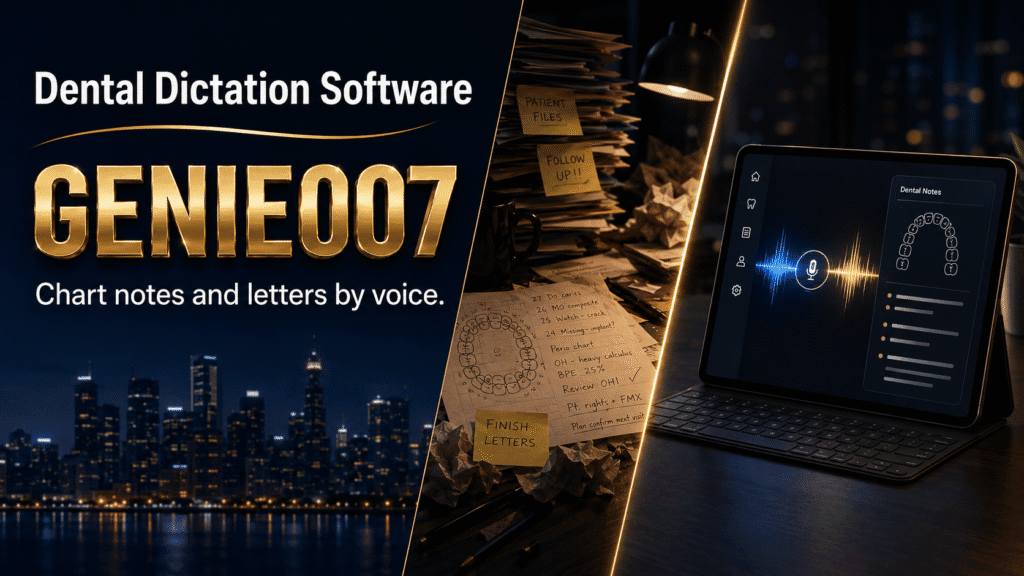
Dental professionals spend their days in gloved hands and sterilised environments, where even a single touch to a contaminated keyboard can spread bacteria and viruses to patients. Beyond hygiene, the paperwork is relentless: clinical notes, referral letters, treatment plans, insurance forms. Most dentists lose 45–60 minutes daily to documentation alone — time stolen from patient care. Traditional dictation apps force you to recite every comma and full stop. Dental dictation software that understands context transforms this bottleneck: speak naturally about a patient’s perio condition or treatment plan, and let AI deliver polished clinical notes and referral letters ready to send.
Why Keyboard Hygiene Matters in Dental Practice
The challenge is not theoretical. Dental surgeries follow strict infection-control protocols because the profession handles blood, saliva, and aerosol contamination daily. Once you’re gloved and working chairside, touching a keyboard or mouse becomes a cross-contamination risk. Washing gloves every few minutes is inefficient; changing gloves is costly and wasteful. Most practices work around it by asking receptionists or nurses to handle notes, creating communication gaps and delays.
Published infection-control guidance from the CDC and ADA emphasises minimising unnecessary touchpoints in clinical areas. A contactless documentation workflow — dictating clinical notes without touching input devices — removes this risk entirely. Dental dictation software designed for this workflow lets you document cases, draft referral letters, and communicate with colleagues without ever reaching for a contaminated keyboard.
The Documentation Time Drain: Real Numbers
A typical general dentist or hygienist spends 8–12 minutes per patient on documentation after the appointment: typing clinical notes, charting findings, composing referral letters to specialists, and updating treatment plans. For a busy practice seeing 12–16 patients daily, that’s 96–192 minutes — nearly two hours — of non-clinical work. Add administrative tasks like insurance correspondence and appointment notes, and documentation often exceeds 20% of a dental professional’s day.
The real cost is opportunity cost. Those two hours could be patient consultations, continuing education, or rest between high-stress clinical procedures. Efficient dental dictation software reclaims this time by collapsing the transcription and formatting step. Instead of typing, you speak; instead of reviewing and editing for five minutes, you review and send in 30 seconds.
Voice-Typing Workflow: Before and After
The Old Way: Keyboard Typing and Cleanup
You finish a root canal. You sit at the desk, careful not to contaminate the keyboard (you’ve already changed gloves twice). You type notes from memory, fighting autocorrect and typos. You spend two minutes fixing errors and drafting the referral letter separately in email. Across 15 patients, this costs 90 minutes and constant interruptions to your clinical focus.
The New Way: Voice Dictation, No Touchpoints
You finish the root canal, gloves still on. You say: “Root canal treatment on tooth 36, lateral condensation with gutta-percha, no complications, patient advised on post-operative care.” The software delivers a polished clinical note in seconds. For the referral, you say: “Please fabricate a ceramic crown for tooth 36, shade A2, delivery two weeks.” Another letter ready to send. Across 15 patients, you’ve reclaimed 70–80 minutes and maintained infection control throughout.
Three Concrete Workflows for Dental Dictation Software
Workflow 1: Chairside Clinical Notes (Gloved)
You’re examining a patient with bleeding on probing. You activate voice dictation and say: “Bleeding on probing, generalised plaque, probing depths 4 to 5 mm lower left, 3 to 4 mm elsewhere, no mobility, no fremitus.” The software delivers: “Bleeding on probing. Generalised plaque accumulation. Probing depths: 4–5 mm lower left, 3–4 mm elsewhere. No mobility or fremitus.” Formatted and ready for the record. No keyboard touch. No cross-contamination risk. Dictation takes 20 seconds; typing takes five minutes.
Workflow 2: Referral Letters and Specialist Communication
A patient needs an extraction due to severe decay. You dictate: “Please extract tooth 14 due to unrestorable caries, root treated, associated periapical pathology, patient medically fit for surgery, no allergies to local anaesthetic.” Dental dictation software with context awareness turns that into a professional referral: “I am writing to request extraction of tooth 14. The tooth is unrestorable due to extensive caries, previous root treatment, and associated periapical pathology. The patient is medically fit for extraction and has no known drug allergies. I would appreciate your earliest availability.” Specialist-quality letter in one voice command, no re-reading, no typing.
Workflow 3: Treatment Planning and Patient Communication Notes
After examining a new patient, you dictate a treatment plan: “Class two cavity upper right, recommend composite, one appointment, cost estimate 120 pounds, patient prefers white filling, no complications anticipated.” The software formats this as a patient-safe treatment summary: “Recommended treatment: composite restoration for upper right back tooth, one appointment, estimated cost £120. Material: white composite to match natural teeth. No pre-existing complications.” This note goes to the patient’s record and can be printed or emailed as a treatment plan. Clarity, professionalism, and speed — all voice-driven.
Time Savings and Practice Efficiency Gains
Conservative estimate: 8 minutes per patient × 15 daily patients = 120 minutes (two hours) reclaimed. If your time is worth £75/hour clinically, that’s £150 daily or £36,000 annually — equivalent to a part-time administrator’s salary.
Secondary gains compound: fewer errors reduce liability; faster referrals improve outcomes and specialist relationships; tighter infection control satisfies auditors; reduced friction lowers burnout. Practices adopting dental dictation software report higher throughput and improved staff satisfaction within weeks.
Addressing Concerns: Accuracy, Privacy, and Learning Curve
Accuracy
Modern AI dictation achieves 99%+ accuracy in quiet environments, even for technical terminology (probing depths, gutta-percha, periapical) when trained on dental language. Initial reviews take 30 seconds per note. After a week of use, you’ll spot-check rather than review line-by-line. Most practices report a net time saving even after accounting for review and correction.
Privacy
Dental patient data is sensitive and regulated (GDPR in the UK, HIPAA in the US). Reputable dental dictation software operates on-device or with end-to-end encryption, meaning your audio and clinical notes never touch a cloud server. Look for privacy-first tools that guarantee zero data retention and compliance with healthcare regulations. This is non-negotiable in a medical practice.
Learning Curve
Dictation feels unnatural for the first 2–3 days. You’ll stumble over phrasing and worry about sounding awkward. By day five, it’s second nature. Most practitioners who try it for a week don’t go back to typing because the speed and ergonomic relief are too compelling. Start with routine notes (simple restorations, exams) before trusting it with complex cases.
Genie 007: Dental Dictation Software Built for Hands-Free Clinical Work
Genie 007 is a think-to-text voice AI that runs on Windows, Mac, mobile, and as a browser extension, so you can dictate from any device without leaving your clinical workflow. Unlike basic speech-to-text, it understands context and intent, so when you speak about “probing depths and plaque,” it delivers polished, professionally formatted clinical notes — no “comma” or “full stop” commands needed. You speak naturally; it outputs professional text.
For dental practices, this means dictating referral letters, treatment plans, and clinical notes directly into email, your practice-management system, or a text editor, all without touching a contaminated keyboard. The audio is processed on-device or encrypted end-to-end, so your patient conversations stay private — GDPR compliant, HIPAA-ready. And because it works across platforms, you can dictate from Windows in the surgery, continue on your Mac at lunch, and send follow-ups from mobile without re-learning an interface.
The tool is built around voice-first workflows: you don’t dictate every word; you speak your intent and let AI refine it into professional output. For a dental practitioner pressed for time and concerned about hygiene, this reclaims both time and peace of mind.
Getting Started: Making Dictation Routine
Start with low-stakes dictation: routine treatment notes, recall appointment reminders, and simple referrals. Once you’re comfortable, expand to complex cases and patient communication letters. Most practices see full adoption within 2–3 weeks and report that the practice-wide time saving justifies the small learning investment.
Set up a voice shortcut or macro for common phrases (“patient medically fit for treatment”, “no complications anticipated”) to speed things up further. Some practices use dictation as a break between clinical procedures — stand up, dictate three notes aloud, sit back down refreshed and documented. Small habit shifts compound into massive time savings.
FAQ: Voice Typing and Dental Documentation
Can dictation software understand dental terminology like “perio charting” and “gutta-percha”?
Yes, modern AI dictation trained on healthcare and dental language achieves 99%+ accuracy on technical terminology. If your software struggles with a term, you can add it to a custom dictionary or rephrase slightly. Most practitioners find that four or five common terms account for 80% of their dictation, so the learning curve is quick.
Is voice dictation secure enough for patient data in a dental practice?
Reputable healthcare dictation software uses end-to-end encryption or on-device processing, meaning audio and text never touch an unencrypted server. Look for GDPR compliance and HIPAA-ready credentials. Genie 007, for example, processes voice on-device or with AES-256 encryption, zero data retention, and zero logging — your patient conversations stay in your practice.
How much time will dictation actually save in a busy dental practice?
A conservative estimate: 8–12 minutes per patient in documentation time. For a practice seeing 12–16 patients daily, that’s 1.5–3 hours reclaimed. Add in faster specialist referrals and reduced back-and-forth with staff, and the time saving often exceeds three hours daily. Financially, that’s equivalent to reclaiming a quarter to half of a part-time administrator’s salary, pure margin.
Try Genie 007 Free
Dental dictation software eliminates the cross-contamination risk of chairside keyboards and reclaims 1–3 hours daily lost to documentation. Genie 007 lets you voice-type clinical notes, referral letters, and treatment plans hands-free, directly into email and your practice-management system, with privacy that meets healthcare regulation.
Download Genie 007 free — available for Windows, Mac, mobile and as a browser extension. No credit card required.
Written by Bill Kiani, founder of Genie 007.