
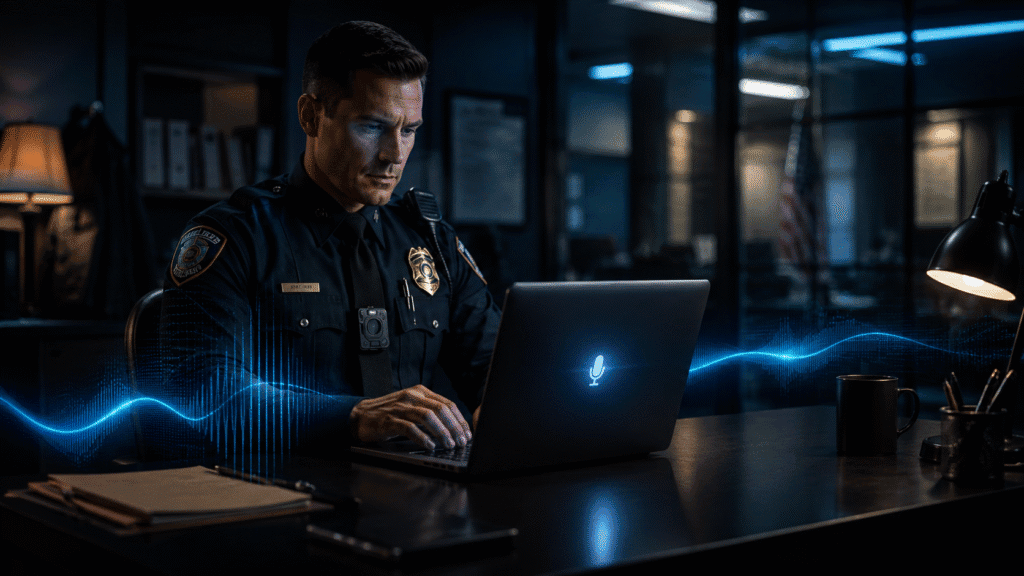
Police officers across the UK and US consistently spend three or more hours per shift completing documentation — time taken directly away from patrol, response, and community engagement. According to the U.S. Department of Justice COPS Office, AI-assisted police report writing software is now helping departments cut that burden substantially, with some agencies reducing individual report completion times from over an hour to under twenty minutes. This article explains how voice dictation and police report writing software works in practice, which workflows deliver the biggest time savings, and what officers need to know before choosing a tool for desk or field use.
How Much Time Does Report Writing Actually Steal?
A national survey of law enforcement professionals found that 56 per cent spend three or more hours per shift writing incident reports and completing documentation rather than actively policing. A further 39 per cent spend up to four hours per day on paperwork alone. Across a standard ten-hour shift, the average officer loses between three and four hours to a keyboard before they ever write up a serious incident.
The problem compounds as call volume increases and staffing stays flat. Officers regularly remain on duty after their shift ends not because the streets demand it, but because reports could not be finished during working hours. Police Chief Magazine surveys consistently identify report writing as the single biggest productivity drain cited by officers — ahead of court appearances, training days, and administrative meetings combined. It is a significant finding for any force trying to improve officer wellbeing, response times, and community visibility.
The core issue is speed. The average person types roughly 35 to 40 words per minute but speaks at 100 to 130 words per minute. A 600-word incident narrative takes around fifteen minutes to type and under five minutes to dictate. Multiply that across five or six reports per shift and the arithmetic becomes unavoidable: officers are spending a disproportionate share of every shift doing something a microphone and the right software could handle far faster.
What Police Report Writing Software Actually Does
The term “police report writing software” covers three broadly different approaches. The first is RMS-native report writers — software built into a Records Management System that standardises fields, auto-populates repeated data, and enforces consistent formatting. These help with structure but still require officers to type every word of the narrative section, which is where most of the time goes.
The second approach is a dictation layer: voice-to-text that sits inside or alongside an existing RMS, allowing officers to speak their report rather than type it. This is where the biggest practical time savings come from. Dictation for police officers means a report can be spoken while details are still fresh — immediately after an incident, in the vehicle, or back at the station — rather than reconstructed from memory hours later when fatigue has set in.
The third approach uses AI to draft reports from body-worn camera audio. These tools carry their own legal, accuracy, and admissibility considerations, as the Department of Justice has noted — and for most officers, reliable law enforcement dictation software remains the most practical and legally straightforward starting point for reducing report time.
Any credible police report writing software needs to handle law enforcement vocabulary accurately, work across the platforms officers actually use — Windows desktop in the station, mobile in the field — and keep sensitive data private. Each of those requirements has a direct bearing on which tool is worth adopting.
Five Workflows Where Voice Dictation Changes Everything
1. Immediate Capture After an Incident
The most valuable time to record what happened is the first ten minutes after an incident concludes. Details are accurate, sequence is clear, and nothing has been rationalised or forgotten. With voice to text police reports running on a mobile device, an officer can speak the full incident narrative before leaving the scene — time, location, parties involved, actions taken, evidence noted — and that dictation carries directly into the RMS with only light correction needed. Waiting until end of shift means relying on memory, which degrades significantly within hours of the incident.
2. In-Vehicle Report Completion
Many officers complete shorter reports sitting in their vehicles between calls. A mobile dictation solution that works in varied acoustic environments turns that dead time into productive time. Genie 007’s mobile app handles this workflow cleanly, converting speech to formatted text that transfers directly into a report form or station system. Two minutes of dictation in the vehicle eliminates what would otherwise be a forty-minute typing session at end of shift. For field officers working without easy access to a station desk, this is the most practical upgrade available.
3. Desk-Based Detailed Reporting
For complex incidents — serious assaults, domestic cases, road traffic collisions — a desk-based session using a Windows application with a quality microphone produces the most thorough output. Genie 007’s Windows app works inside any text field on the desktop, including directly within the RMS, without tab-switching or copy-paste loops. Officers who also need to send update emails to supervisors or referral notes to partner agencies can use the same tool for dictating directly in Outlook, keeping the entire reporting workflow consistent rather than switching between tools.
4. Witness and Evidence Notes
Beyond formal incident reports, officers routinely capture witness accounts, evidence descriptions, and scene observations throughout a shift. Voice dictation handles each of these as naturally as the main narrative. The same tool used for reports works for supporting documents and supplementary notes, which keeps the training requirement to a minimum and encourages consistent use rather than defaulting back to typing for shorter tasks.
5. Reviewing and Amending Reports
Officers often need to supplement or correct reports after additional information emerges. Dictating amendments rather than retyping them is faster and reduces errors that arise from manual re-entry. Speaking a correction aloud updates the document without touching the keyboard, and first-draft quality from dictation is typically high enough that amendments are brief and focused rather than extensive rewrites.
The Time-Savings Maths
Let us put numbers to the before-and-after scenario. An officer handling six incidents per shift, each requiring a 500-word narrative, faces 3,000 words of report writing. At 38 words per minute typing speed, that is approximately 79 minutes of typing time for the narratives alone — before form completion, RMS navigation, or supervisor review. That is more than an hour and a quarter spent simply entering words into a keyboard.
| Method | Speed | 6 x 500-word reports | Typical overrun? |
|---|---|---|---|
| Typing | 38 wpm average | ~79 minutes | Frequent |
| Voice dictation | 120 wpm spoken | ~25 minutes | Rare |
| Think-to-text (Genie 007) | 120 wpm + AI formatting | ~20 minutes, less review needed | Minimal |
Across a team of ten officers, that is more than ten hours of capacity returned per shift. For a department running two or three shifts daily, voice-based police report writing software could reclaim the equivalent of a full-time officer’s working hours every day without any additional headcount. See the Genie 007 pricing page to compare the subscription cost against the overtime budget those saved hours typically consume.
Accuracy, Privacy, and the Learning Curve
Accuracy. Modern voice-to-text achieves 95 to 99 per cent word-level accuracy in good conditions. Officers who speak at a steady pace, in a normal voice, without heavy background noise report very few errors in practice. Law enforcement vocabulary, policing terminology, and UK location names can be added to a custom dictionary in any capable tool to further reduce the correction rate.
Privacy. Incident reports contain sensitive personal data — victims, witnesses, suspects, and often minors. Genie 007 processes audio on-device with AES-256 encryption, no audio storage, and zero data retention after a session ends. Administrators reviewing data governance obligations should read about how Genie 007 handles secure, HIPAA-ready dictation — the same compliance rigour that protects medical records applies directly to law enforcement sensitive data.
Learning curve. Officers used to typing sometimes find dictation feels unnatural initially. The adjustment typically takes one to two shifts. Speaking the narrative as if briefing a colleague — in plain, direct language rather than formal report style — produces better results than attempting to dictate stiff formal phrasing from the outset. Structure and phrasing can be refined during the review step, which takes far less time than writing from scratch.
Beyond Transcription: How Think-to-Text Changes the Report
Standard law enforcement dictation software delivers what you say, word for word. That is already faster than typing — but it still requires an officer to hold the full structure of a report in their head before speaking. Genie 007 goes a step further with what it calls think-to-text. Rather than transcribing speech literally, it interprets intent and delivers a polished, structured output.
An officer can speak the key facts of an incident in whatever order they recall them — parties involved, actions taken, outcomes noted, evidence referenced — and Genie 007 assembles those fragments into a coherent, properly sequenced narrative ready for review and submission. For officers who regularly write complex multi-party reports, the think-to-text approach is a meaningful step beyond plain transcription.
Frequently Asked Questions
What is police report writing software?
Police report writing software is any digital tool that helps officers create, structure, and submit incident reports more efficiently. It ranges from standardised form fields within a Records Management System to voice dictation tools that convert speech to text. The most widely adopted starting point is voice-to-text dictation, which allows officers to speak reports rather than type them — typically cutting completion time by 50 to 70 per cent per incident.
Can police officers use voice-to-text for official reports?
Yes. Voice-to-text dictation for police reports is used across law enforcement agencies in the UK and US. Officers dictate into a tool that converts speech to text, review and correct the output, then submit through their standard RMS. The officer remains responsible for accuracy and signs off the final document. Admissibility concerns associated with fully automated AI-drafted reports do not apply to officer-reviewed dictation-based tools, where the officer authors and verifies every word before submission.
How accurate is voice dictation for law enforcement reports?
In good audio conditions — a quiet vehicle, a station office, or a desk with a microphone — modern voice dictation for police officers achieves 95 to 99 per cent word-level accuracy. Errors are typically minor and caught during review. Accuracy improves with a consistent speaking pace and a user profile trained to the individual officer’s voice.
Is dictation software secure enough for sensitive police data?
Security depends entirely on the tool chosen. Genie 007 uses AES-256 encryption, processes audio on-device with no server-side audio storage, and retains zero data after a session ends. Sensitive personal data in an incident report never leaves the officer’s device or browser session. Forces with UK GDPR data governance requirements should verify that any tool they adopt confirms that no audio or transcript is stored on third-party servers before deployment.
Try Genie 007 Free
If report writing is costing your officers an hour or more per shift, voice dictation is the fastest practical fix available. Genie 007 works across desk and field — speak your report, get a polished narrative, and finish your shift on time rather than staying late to type.
Download Genie 007 free — available for Windows, Mac, mobile and as a browser extension. No credit card required.
Written by Bill Kiani, founder of Genie 007.