
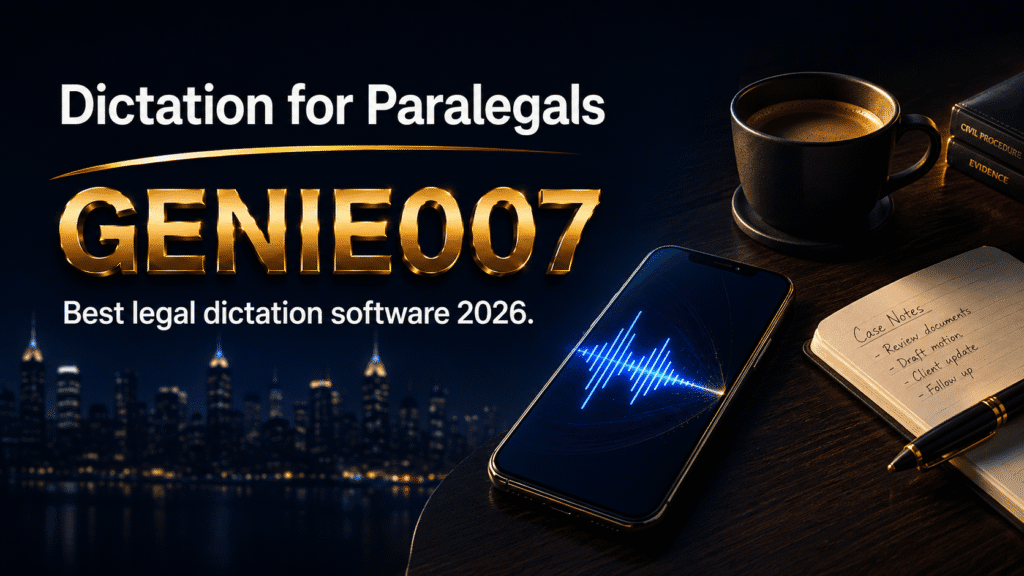
Paralegals spend hours daily typing case notes, drafting intake summaries, and logging billable time—without premium legal-grade dictation budgets. If you’re managing multiple cases whilst meeting billing targets on a tight budget, the right dictation software for paralegals is a practical tool to reclaim time and reduce strain. This guide covers the best dictation software for paralegals available today, comparing built-in options with dedicated tools, and why voice-to-text can cut administrative load by hours weekly.
The Paralegal Dictation Challenge
Unlike lawyers with dedicated administrative support, paralegals juggle multiple roles: client intake calls, case notes, correspondence, and time tracking—all whilst maintaining confidentiality and accuracy. The volume is significant; most paralegals spend 50%+ of their day drafting or annotating documents, mostly through typing. Built-in dictation tools (Windows Voice Typing, Apple Dictation, Google Docs voice) are free but have blind spots: they transcribe literally (forcing you to say “period, comma”), don’t understand your office’s terminology or case codes, and force constant app-switching. For paralegals capturing legal detail at scale, these limitations add up.
Built-In vs. Dedicated Dictation Software
Built-in dictation (Windows Voice Typing, Apple Dictation, Google Docs voice) is free and works in most applications. The catch: they transcribe literally, so you’re constantly saying “period,” “comma,” “new paragraph”—breaking your composing flow. They don’t understand your office’s case-numbering system or legal abbreviations, and moving between Word, Outlook, and your practice management software means constant context-switching or copy-pasting. For paralegals handling sensitive client data, on-device privacy is good, but the output still lives in systems accessible to others.
Dedicated dictation software designed for productivity understands intent—you dictate a thought (“summarise the plaintiff’s account from the deposition”) and get back clean, formatted text ready to edit, not a raw transcript you need to restructure. This is especially useful during client intake calls: you listen fully to the client instead of simultaneously dictating and punctuating. It’s also faster for billing time and case-coding. Specialised legal dictation runs £15–50/month per user; more affordable options that work across platforms become essential for paralegals on a tighter budget.
Dictation Software for Paralegals: Built-In Options vs. Genie 007
The honest comparison comes down to what you’re doing with the dictation. For occasional voice notes, Windows Dictation or Google Docs voice typing work fine. For your primary workflow—especially if you’re handling multiple cases, switching apps constantly, or working across platforms (Windows at the office, Mac at home, mobile during site visits)—a unified tool saves frustration and time.
| Feature | Windows Voice Typing | Mac Dictation | Google Docs Voice | Genie 007 |
|---|---|---|---|---|
| Cost | Free (Windows 11+) | Free | Free (Google account) | £5–10/month |
| Platforms | Windows only | Mac only | Browser only | Windows, Mac, mobile, browser |
| Works in all apps | Most apps | Most apps | Google Docs only | Yes, every app and website |
| Automatic punctuation | Basic | Basic | Good | Yes, learns your style |
| Intent-based output (think-to-text) | No, transcription only | No, transcription only | No, transcription only | Yes (Genie Mode) |
| Privacy (nothing stored after processing) | Yes | Yes | No, cloud | Yes |
| Multiple languages/translation | No | No | No | 140+ languages, live translation |
For a paralegal working across platforms—using Windows at the office, borrowing a Mac for a document review, checking emails on a phone whilst waiting for a hearing—built-in tools mean learning three different dictation interfaces. Genie 007 offers one consistent voice interface across all four: Windows app, Mac app, mobile app, and browser extension. You speak once; it delivers formatted text that’s ready to use, whether you’re in Word, Outlook, your practice management portal, or a web form.
How Genie 007 Speeds Up Paralegal Workflows
The core difference between transcription and think-to-text matters for paralegals. Traditional dictation captures your words literally; you then edit and restructure. Genie Mode lets you speak your intent—”Based on the deposition, summarise the defendant’s negligence admissions”—and it generates the structured output, ready to review. That’s a transcript versus an outcome.
In practice: during client intake, you listen fully instead of typing notes, then dictate a summary afterwards. For deposition highlights, you flag key testimony (“defendant states no safety inspections for six months”) and Genie 007’s automatic formatting makes your notes immediately usable. For billing, you dictate “client meeting with Jane Smith, 6.25 hours” and it formats correctly for your practice management system. And because Genie 007 works on Windows, Mac, mobile, and browser extension, you use the same interface everywhere—your personal writing style follows you across all four platforms.
Privacy and Confidentiality
Paralegals handle confidential, sometimes privileged client information. Built-in dictation sends voice to Google’s servers (Google Docs) or keeps it local (Windows, Mac). Genie 007 encrypts your audio in transit, processes it in real time and stores no recordings and no transcripts. For sensitive matters, that privacy model aligns with professional standards. The software is GDPR compliant and stores no recordings or transcripts, which matters for international work.
Cost and Budget Reality
Genie 007 pricing starts at £5 per month for the Mini plan, scaling to £10/month for the Ultra plan. Compare that to premium legal dictation software (£40–100/month), and it’s immediately clear why paralegals can justify the cost. For a law firm with five paralegals, the annual cost is £300–600 instead of £2,400–6,000 for specialised legal tools. That matters on a paralegal’s salary and on your firm’s operational budget.
There’s also a free trial, no credit card required, so you can test it against your actual workflows before committing.
Paralegals vs. Lawyers: Different Dictation Needs
You might wonder why paralegals can’t use the same premium dictation tools as lawyers. Lawyers often have institutional budgets for £50+/month subscriptions (the firm absorbs billable-work costs). Paralegals manage more administrative, lower-billable-rate tasks; a premium tool’s ROI is harder to justify. Additionally, specialised legal dictation often has feature bloat paralegals don’t need, with pricing to match. A better model for paralegal work is an affordable, cross-platform tool covering intake, notes, billing, and correspondence—lightweight and portable. For more detail, see dictation software for lawyers.
Getting Started with Voice Dictation
If you’re currently dictating into a phone recorder or using Dictation only for occasional emails, moving to a dedicated tool is a straightforward change with large returns. Start by picking your most-used application (Word, Outlook, or your practice management portal) and spend a week dictating into it using Genie 007. Most paralegals report 30–50% time savings on composition once they stop managing punctuation. Test across your devices—phone, desktop, laptop—to confirm consistency. Spend an hour setting up shortcuts for common matter codes, client names, and legal phrases; Genie 007 learns your style and becomes faster over time. If your paralegal team shares a practice management system, adopting Genie 007 together ensures consistent notes and terminology.
Common Questions About Dictation Software for Paralegals
Is dictation software accurate enough for legal documents?
For paralegals’ most common tasks—intake summaries, case notes, and correspondence—accuracy is typically 95–99% in normal office conditions. Legal documents requiring precise terminology (contracts, pleadings) are usually drafted by lawyers, not paralegals. Paralegals use dictation primarily for notes and administrative work, where accuracy is high and editing is quick. Built-in dictation and Genie 007 are both reliable for this work. For highly technical or industry-specific terminology, you may need a brief review, but that’s still faster than typing from scratch.
Can I use dictation software during depositions or court appearances?
Many courts allow paralegals to take notes on their devices during depositions and hearings, but real-time dictation into a microphone would be disruptive and likely not permitted. Genie 007’s strength is post-meeting note capture: after a deposition, you can dictate your summary and key facts quickly. Some paralegals use voice dictation to prepare witness summaries or flag testimony sections from a transcript whilst reviewing, which works seamlessly with Genie 007 on your laptop or phone.
What if I work in a noisy office or courtroom building?
Accuracy degrades in high noise (below 50dB ambient, dictation is reliable; above 70dB, you’ll see more errors). If you’re frequently in noisy environments, dictate during quieter moments—break time, early morning, or your own office space. Many paralegals dictate their deposition notes or case summaries at the end of the day when the office is quieter, rather than attempting real-time note capture in a noisy courthouse.
Does using dictation software require any training or setup?
No formal training required, but spending 15 minutes configuring shortcuts and terminology in Genie 007 speeds up your workflow significantly. Most paralegals are productive with voice dictation within their first day of use, especially if they’re replacing manual typing rather than learning to dictate for the first time. The learning curve is shallow.
Can paralegals use live translation in Genie 007 for multi-language client communications?
Yes. If you’re working with clients, witnesses, or documents in another language, Genie 007’s live translation feature works across 140+ languages. You can dictate in English and get output in Spanish, French, Mandarin, or another language—useful for international cases, immigrant client services, or multilingual discovery. It’s a competitive advantage over built-in tools, which don’t support translation.
How much money can a paralegal actually save by using dictation software?
Time savings vary, but most paralegals report saving 5–8 hours per week once they integrate dictation into their daily workflow. At a typical paralegal billing rate of £60–100/hour, that’s £300–800 per week in recovered time. Even if only 20% of that is billable (the rest is administrative), you’re recovering £1,200–3,200 per quarter—more than offsetting the annual cost of the software many times over. The non-financial benefit, reduced hand strain and faster case note capture, is equally important.
Try Genie 007 Free
If you’re handling high volumes of case notes and client intake without a specialised tool, dictation software for paralegals isn’t a luxury—it’s a practical efficiency gain. Genie 007 brings think-to-text capability to your daily workflow across every platform you use, from Windows and Mac to mobile and browser, without the premium price tag of specialised legal software.
Download Genie 007 free — available for Windows, Mac, mobile and as a browser extension. No credit card required.
Written by Bill Kiani, founder of Genie 007.