
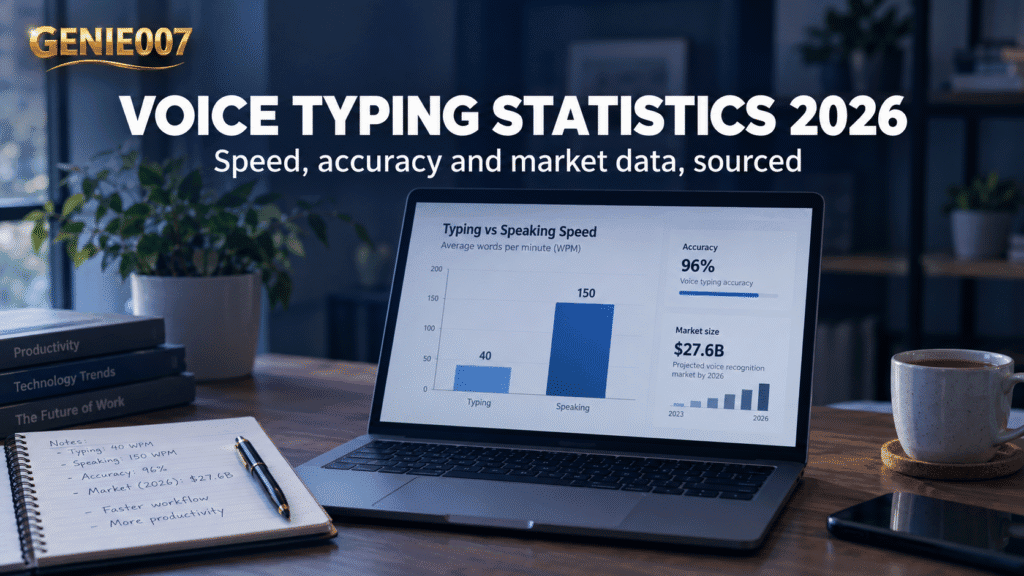
Voice typing statistics from published research put speech input at nearly three times the speed of phone typing: 153 against 52 words per minute in a 2017 lab study. On one standard benchmark, software has matched professional human transcribers, though errors rise for some speakers and settings. Every figure below has a linked source and year.
Last checked on 13 October 2026. These voice typing statistics come from papers, public bodies and research firms’ own pages, and each table gives the figure, source and year. Where studies measure different things, we say so and never average them.
Voice typing statistics on speed
Speed is measured in words per minute (WPM). One Stanford, University of Washington and Baidu study compares speech with the phone keyboard directly, and two large Aalto University studies give typing baselines.
| Statistic | Figure | Source | Year |
|---|---|---|---|
| Speech vs on-screen keyboard, English (iPhone) | 153 WPM vs 52 WPM, 2.93 times faster | Ruan et al., IMWUT | 2017 |
| Speech vs on-screen keyboard, Mandarin | 123 WPM vs 43 WPM, 2.87 times faster | Ruan et al., IMWUT | 2017 |
| Typing on a physical keyboard, average | 51.56 WPM, with 1.167% uncorrected errors (168,960 volunteers) | Dhakal et al., CHI | 2018 |
| Fastest typists in that dataset | 120 WPM or more | Dhakal et al., CHI | 2018 |
| Typing on a phone, average | 36.2 WPM, with 2.3% uncorrected errors (37,370 volunteers) | Palin et al., MobileHCI | 2019 |
What it means: speech beat the touchscreen keyboard by close to three times in a controlled setting. Early coverage from Stanford and the University of Washington in 2016 rounded this to about 3x; the peer-reviewed paper gives 2.93x for English and 2.87x for Mandarin.
It does not mean every task is three times faster. Participants entered short messages in a lab using Baidu’s Deep Speech 2 recogniser, and the physical-keyboard average comes from people who chose to use a commercial typing site, so it is not a random sample. Our guide to dictation vs typing speed works through everyday examples.
Speech recognition accuracy statistics
Accuracy is reported as word error rate (WER): substituted, deleted and inserted words as a share of the words actually spoken, so lower is better. A 5% WER is about one wrong word in 20.
| Statistic | Figure | Source | Year |
|---|---|---|---|
| Human transcribers vs a Microsoft research system, conversational phone speech (Switchboard) | 5.9% human, 5.8% system (CallHome: 11.3% and 11.0%) | Xiong et al., Microsoft | 2016, revised 2017 |
| OpenAI Whisper large-v2, read audiobook speech (LibriSpeech) | 2.7% WER on clean audio, 5.2% on other | Radford et al., OpenAI | 2022 |
| Whisper training audio | 680,000 hours, of which 117,000 hours cover 96 languages other than English | Radford et al., OpenAI | 2022 |
| Errors left in the final text, speech vs phone keyboard | 1.30% vs 0.79% | Ruan et al., IMWUT | 2017 |
| Five commercial systems (Amazon, Apple, Google, IBM, Microsoft), average WER | 35% for Black speakers, 19% for white speakers | Koenecke et al., PNAS (Stanford Report) | 2020 |
| Raw speech recognition output for dictated clinical notes | 7.4% error rate, falling to 0.4% after transcriptionist review and 0.3% in signed notes | Zhou et al., JAMA Network Open | 2018 |
What it means: WER scores only compare like with like. LibriSpeech is read speech, Switchboard is unscripted phone talk, and the clinical notes were dictated in 2016 with Dragon Medical 360 eScription, so a good score on one test is not a promise for the others.
The 2020 study is the caution: an average can hide a large gap between speakers, and it did not test newer versions of those systems. Human review made the biggest difference in the clinical notes, cutting errors from 7.4% to 0.3%. For what improves everyday results, read how accurate voice to text is.
Voice assistant and dictation usage stats
We found no primary source that counts dictation use directly, so the dictation usage stats below rely on voice assistant data, a related but different habit. For voice search statistics 2026, note that the newest primary figures we could fetch date from 2024 and 2025, and none isolates voice search.
| Statistic | Figure | Source | Year |
|---|---|---|---|
| US adults who say they use digital voice assistants | 46%, including 42% on a smartphone | Pew Research Center | 2017 |
| UK adults who used a voice assistant in the past three months | 54% | Ofcom, Audio listening in the UK 2025 | 2025 |
| UK households with a smart speaker | 41% | Ofcom Technology Tracker, cited in the same report | 2024 |
| People aged 16 to 74 in the EU using a virtual assistant in the form of a smart speaker | 16.0% | Eurostat | 2024 |
| Clinicians satisfied with speech recognition for documentation | 78.8% satisfied; 77.2% agreed it improves efficiency | Goss et al., Int J Med Inform | 2019 |
What it means: these figures count people who have used a voice assistant, not people who dictate documents, and the questions differ. Pew asked about use in general, Ofcom about the past three months, and Eurostat about smart speakers only, so compare within a row, not across.
The Pew survey dates from 2017, so treat it as a historical marker, not today’s rate. The clinician survey was sent in 2016 and 2017 to people who already used speech recognition at two medical centres, so it shows satisfaction among users, not how many clinicians dictate.
Speech recognition market statistics
Market figures come from research firms, each with its own scope. We quote only numbers stated on the firm’s own public page, and every row is that firm’s estimate or forecast, not a measurement.
| Statistic | Figure | Source | Year |
|---|---|---|---|
| Voice and speech recognition market size | USD 20.2 billion | Grand View Research estimate | 2023 |
| Estimated market size | USD 31.7 billion | Grand View Research estimate | 2026 |
| Projected market size | USD 53.7 billion, a 14.6% CAGR from 2024 to 2030 | Grand View Research forecast | 2030 |
| Speech and voice recognition market size | USD 9.66 billion | MarketsandMarkets estimate | 2025 |
| Projected market size | USD 23.11 billion, a 19.1% CAGR from 2025 to 2030 | MarketsandMarkets forecast | 2030 |
What it means: the two 2030 forecasts differ by more than USD 30 billion because the firms define the market differently. Grand View Research’s page lists text-to-speech and speaker verification among its segments, while MarketsandMarkets segments by technology, deployment mode, application and vertical.
Neither is a figure for voice typing alone, and CAGR (compound annual growth rate) is a projection. Use these numbers to say the market is growing, not to say how much of it is dictation.
Accessibility statistics: who may benefit from voice input
No single source counts people who rely on voice input. The figures below size groups for whom typing can be harder, so they show potential need, not usage.
| Statistic | Figure | Source | Year |
|---|---|---|---|
| People with significant disability worldwide | 1.3 billion, 16% of the world’s population | WHO fact sheet | 2023 |
| People with a near or distance vision impairment worldwide | At least 2.2 billion | WHO fact sheet | 2026 |
| US adults with diagnosed arthritis | About 53.2 million (21.2%) | CDC, MMWR | 2019 to 2021 |
| Workers in Great Britain with work-related musculoskeletal disorders | 511,000, of whom 211,000 mainly had upper limb or neck problems; 7.1 million working days lost | Health and Safety Executive | 2024/25 |
What it means: these are prevalence figures. Most people in these groups do not need voice input, and many who do use it for some tasks, not all. The HSE total also counts back and lower limb conditions, so the upper limb or neck figure is the closer guide to strain from typing.
Voice input is one tool among several, and none of these figures says it suits any individual. Professional advice matters too.
This article is for general information only and is not medical advice. If you are experiencing pain or other symptoms, please consult a qualified healthcare professional.
How we chose these sources
Every figure was read on the publisher’s own page or in the paper itself on 13 October 2026, and each link opens that source. We prefer peer-reviewed papers, public-body statistics and research firms’ own pages. We left out widely repeated voice typing statistics that we could not trace to a primary source, and any figure a company publishes about its own product, including Genie 007.
We give the year the data refers to where the source states it, otherwise the year of publication. Surveys differ in country, wording and sample, so we never average them, and older figures stay only where nothing newer was available.
Where voice typing statistics stop
Every number above measures transcription: how fast words are spoken and how many are wrong. None measures the time between needing a reply and sending one. Even at 153 words per minute, plain dictation gives you a draft in your own spoken words, which you still shape and check.
That gap is where Genie 007 fits. Its voice typing mode adds punctuation and grammar as you speak, so you never say “comma”. Genie Mode goes further: in Gmail you say, “Reply to Priya, can’t do Thursday, offer Friday at ten,” and Genie 007 understands the context and writes the finished reply in your tone. It is the idea behind think-to-text, and more explainers sit in our voice typing guides. We have added no Genie 007 figures to the tables.
How to cite this page
Cite the original source for any figure, using the link in its row. To cite this compilation of voice typing statistics, use:
Genie 007. “Voice Typing Statistics 2026.” https://genie007.com/voice-typing-statistics/ (accessed 13 October 2026).
Replace the date with the day you accessed the page, because publishers revise their figures.
Related guides: Windows 11 voice typing commands, voice typing shortcut keys for every app, dictation not working on Mac and ChatGPT voice dictation not working.
Frequently Asked Questions
How fast is voice typing compared to typing?
In a controlled study of phone text entry, speech was nearly three times faster than the on-screen keyboard, at 153 words per minute against 52 in English and 123 against 43 in Mandarin, according to a 2017 paper by Ruan, Wobbrock, Landay and colleagues. Those were short messages in a lab, so everyday gains vary with the task and how much you edit.
How accurate is speech recognition today?
On clean benchmark audio, OpenAI’s Whisper large-v2 scored a 2.7% word error rate on LibriSpeech in its 2022 paper, and a Microsoft research system scored 5.8% on conversational phone speech in a paper first posted in 2016, against 5.9% for professional human transcribers, but real-world accuracy depends heavily on the speaker, the noise and the vocabulary.
How big is the speech recognition market?
Research firms give different estimates because they define the market differently: Grand View Research puts its voice and speech recognition market at USD 20.2 billion in 2023, while MarketsandMarkets estimates its speech and voice recognition market at USD 9.66 billion in 2025, and both forecast growth to 2030. Both are estimates, and neither measures voice typing alone.
How many people use voice assistants?
Surveys find widespread use but ask different questions: Ofcom reported in 2025 that 54% of UK adults had used a voice assistant in the past three months, Pew found in 2017 that 46% of US adults used one, and Eurostat found in 2024 that 16.0% of EU people aged 16 to 74 used a smart speaker assistant.
Try Genie 007 Free
The statistics show how fast and accurate speech has become. Genie 007 puts that speed to work on the finished message instead of the transcript: tell it what you want done, not word by word, just the order.
Free to try, no card needed. Add the browser extension, use it on mobile, or request access to the desktop apps for Mac and Windows.
Written by Bill Kiani, founder of Genie 007.