
You’re composing an email to your UK-based team. Your message is clear in Polish—the exact tone, intent, and urgency—but you’re staring at a blank field in Outlook, trying to translate it into English. Type-to-translate. Paste-to-proofread. Copy back. Send. Three steps, two language switches, and a nagging doubt: does this sound natural? For over 600,000 Polish speakers living and working in the UK, this moment happens daily. The good news: a polish to english voice translator removes that friction entirely. Instead of typing, translating, and polishing separately, you speak your Polish intent once—and get professional English output instantly. That’s what live translation can do. This guide shows you why existing tools fall short, how voice translation actually works, and the concrete workflows that Polish-speaking professionals are using right now to sound native in English across email, Slack, Teams, and beyond.
The Reality of Polish-English Workplace Communication in the UK
Polish is one of the fastest-growing immigrant languages in the UK. The 2021 census recorded over 600,000 Polish speakers in the country, many of them professionals in healthcare, engineering, finance, and education. Yet the workplace still runs on English—emails, meetings, documentation, client communication. For a non-native speaker, especially one thinking and feeling in Polish, switching to English adds cognitive load. You’re not just translating words; you’re recalibrating tone, formality, and context.
The manual approach—type in Polish, run it through Google Translate, edit, send—works. But it’s slow and it’s frustrating. Each step creates a gap between your intended meaning and what arrives. Machine translation is better than it was five years ago, but it still misses nuance: the friendly urgency in “proszę szybko” (please quickly) becomes clunky “please quick”. A traditional voice-to-text tool designed for English speakers won’t recognise Polish phonemes properly. Standard dictation tools force you to switch languages entirely. For Polish professionals writing in English, the workflow has been: think in Polish, type in English, wait, proofread. There’s a faster way.
Why Copy-Paste Translation Loops Break Down Under Real Work Pressure
When you’re drafting an urgent email or replying in a Slack thread, the copy-paste loop slows you down. You’re context-switching between Polish and English mentally, then between your email client and a translation tool physically. Tools like Google Translate or Microsoft Translator handle vocabulary well, but they process text, not intent. The sentence “Zrobimy to jak się da” could mean “We’ll do our best” or “We’ll make it happen” depending on context—a tool will guess, you’ll second-guess, and five minutes vanish.
Built-in dictation tools add another problem. Windows Voice Access, Apple Dictation, and Google Docs Voice Typing assume you’re speaking the language you want to output. Speak Polish, and they’ll either reject it, transcribe it phonetically (producing gibberish), or force you to enable a Polish-language interface—which then means you’re dictating in Polish and manually translating the output anyway. You’ve saved maybe ten seconds at the cost of tool friction.
Where copy-paste tools really break is tone. Professional English in a formal email has rhythm. Polish phrasing doesn’t map one-to-one. A tool translates literal words, but a human (or an AI trained on intent, not just vocabulary) knows that “Mam wiadomość” deserves “I wanted to let you know” in a professional email, not “I have news”. The traditional translator doesn’t grasp the context of the workplace or the reader’s expectations. That’s where live translation changes the game.
How Polish-to-English Voice Translation Works in Practice
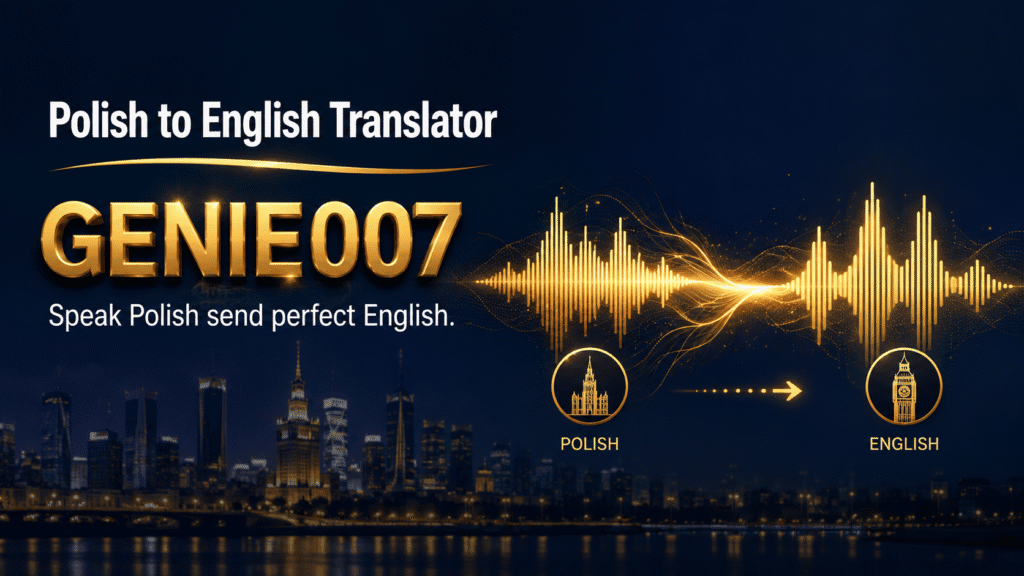
A modern polish to english voice translator built on think-to-text AI does something different. You speak naturally in Polish. The AI listens not just for words, but for your intent—the context, the tone, the goal. Then it generates proper English output, tailored to your workflow. Inside Gmail, Outlook, LinkedIn, Slack, or Teams—no switching tabs, no copy-paste, no manual rewrite.
Here’s a concrete example. You’re a project manager responding to a colleague about a delayed deliverable. In Polish, you’d say: “Wiem, że jest opóźnienie. Przesunęliśmy terminy, ale teraz wszystko powinno być na torach. Daj mi znać jeśli będą problemy.” A traditional tool produces: “I know there’s a delay. We moved the deadlines, but now everything should be on the tracks. Let me know if there are problems.” A think-to-text translator, trained to recognise professional workplace intent, delivers: “I’m aware of the delay. We’ve pushed the timeline back, but we’re back on track now. Let me know if you hit any blockers.” Same facts, but now it reads like a native English manager. No jargon, no stiffness.
The workflow becomes: open Gmail, click into the compose field, activate the voice translator, speak in Polish. The tool processes in real time and types the English output as you speak. When you’re done, you review—because you always should—hit send. Total time: the length of what you actually want to say, not the length of thinking, typing, switching, pasting, and rewriting.
This works across platforms. Whether you’re drafting an Outlook email, replying in Slack, posting on LinkedIn, or typing in Teams, the translator works inside the interface. It understands the context of professional writing in each platform and adjusts formality accordingly. A Slack message is friendlier than an email; the translator knows that. For a full overview of how multilingual voice AI reshapes workplace communication, the capabilities go far beyond Polish-to-English: 140+ languages, regional accents, and real-time output.
Accuracy, Nuance, and Building Trust with Native Speakers
The first objection is always: “Won’t it make mistakes?” Modern voice-to-text AI trained on 140+ languages (including Polish and its regional accents) is remarkably accurate. But accuracy isn’t the only test. A tool can transcribe every word correctly and still miss tone. In professional English, saying “I understand the issue and we’ll fix it” lands completely differently than “I understand. We’ll fix it.” The comma placement, the pause, matters. A translator that understands intent, not just vocabulary, knows when you’re reassuring and when you’re stating facts.
Polish speech has phonetic characteristics that English speech-to-text tools have historically struggled with. The “ł” sound, the nasal “ę” and “ą”, the zh/sz combinations—generic dictation fails. But a translator trained specifically on Polish phonemes and given access to professional English vocabulary handles it. Your accent doesn’t disappear (it shouldn’t), but your message comes through clearly and naturally.
A key advantage is privacy. Your Polish thought, your workplace message—that stays on your device or in end-to-end encryption. The AI processes your intent locally; nothing touches a translation server, no content is logged, no data is resold. For professionals handling sensitive projects, client data, or confidential team updates, this matters enormously. You’re not uploading your business communication to a cloud translator. You’re processing it privately and outputting English directly into your email client. Learn more about how voice typing for non-native English speakers removes both the friction and the worry of being misunderstood.
When You Might Use Other Tools (And When Not To)
If you’re translating a finished document (a PDF, a downloaded report, an article), a standalone translator like Google Translate or Microsoft Translator makes sense. If you’re learning English grammar and want to see word-for-word translations to improve your own typing, that’s useful too. If you need to translate Polish legal documents or technical specifications with 100% human oversight, hire a professional translator.
But if you’re a Polish-speaking professional trying to write fluent English under time pressure—in Outlook, in Slack, in a LinkedIn message, in a Teams thread—a copy-paste workflow is a bottleneck. A voice translator that works inside your tools and preserves intent is not just faster; it’s the difference between sounding rushed and sounding confident.
Frequently Asked Questions
Will a Polish-to-English voice translator work if I have an accent?
Yes. Modern AI trained on 140+ languages and thousands of accents—including Polish, Ukrainian, and Eastern European regional variations—handles accents as standard. In fact, the AI’s job is to understand your intent despite accent variation and deliver native-sounding English output. That’s the whole point. You keep your identity; your message sounds polished.
Can I use live translation in Outlook, Gmail, and Teams at the same time?
A tool designed for cross-platform compatibility works inside every major email, chat, and productivity app—Outlook, Gmail, LinkedIn, Slack, Teams, Zoom, Notion, and more. You activate it once and it’s available everywhere. No reinstalling, no extension for each app. This is where browser extensions and platform-wide apps (Windows, Mac, mobile) shine over single-platform solutions.
What if the translation isn’t quite right?
You review and edit before sending. The tool is fast, not infallible. Most professionals find that 90% of the output is ready to send, and 10% needs a minor tweak (a name, a specific project code, a local reference). That’s still a massive time save compared to typing the whole thing in English from scratch or waiting for a manual translation.
Try Genie 007 Free
Speaking Polish at work and writing professional English doesn’t have to mean typing, translating, and rewriting. Genie 007’s live translation turns your Polish intent into polished English instantly—inside your email, Slack, Teams, or any other app you use daily. Speak once, send with confidence.
Download Genie 007 free — available for Windows, Mac, mobile, and as a browser extension. No credit card required. See pricing and plans for Ultra and Teams options.
Written by Bill Kiani, founder of Genie 007.