
Caseworkers are drowning in paperwork. A typical social worker spends 10–15 minutes writing a single case note — multiplied across 20–30 active cases per caseload, that’s 4–7 hours per week lost to documentation alone. Yet case notes matter: they’re the legal record, the memory of progress, the shield against liability. Dictation software for social workers changes this equation entirely. Instead of typing, you speak your observations into a system that structures them automatically, embeds them into your case-management platform, and protects sensitive client data with GDPR-grade encryption. This guide shows you how caseworkers are cutting documentation time in half whilst improving note quality.
The Hidden Cost of Case-Note Writing
Social workers and case managers face a relentless administrative burden. According to research from the Dropbox social work burnout analysis, excessive paperwork is a top driver of caseworker burnout and retention crises. On average, each case note takes 10–15 minutes to compose—not because workers are slow, but because proper documentation demands specificity, chronology, and often compliance with multiple templates (SOAP, DAP, GIRP, or organisation-specific formats). For a caseload of 25 clients with weekly updates, that’s 2.5–6.25 hours per week of desk time that could be spent counselling, crisis intervention, or relationship-building.
The burnout spiral is real: fewer desk-based hours mean more client face-time seems appealing, but skipped or late documentation creates liability gaps, missed trends, and demoralised teams. When caseworkers spend a third of their day writing instead of practising their craft, organisational turnover climbs. In children’s social services, adult mental health teams, and community care, the pattern repeats: underfunded staffing + complex documentation = retention crisis.
Before and After: A Caseworker’s Day
Before dictation: You finish a home visit at 3 pm. Back at the office, you open your case-management system and spend the next 45 minutes reconstructing the visit from memory: observations about the child’s behaviour, parent engagement, signs of progress, concerns noted, next steps. You format it into SOAP structure (Subjective, Objective, Assessment, Plan), copy-paste dates, cross-check against your handwritten notes. Email arrives; you’re interrupted. The note takes an hour. You do two more notes before 5 pm, then stay late to finish others. By 6 pm, three notes are still pending, stress rises, and the evening disappears.
After dictation: You finish the home visit at 3 pm. On your phone or laptop, you open Genie 007 and spend 3 minutes speaking: “Note for Sarah—home visit today, she’s engaging well with the art therapy, Mum’s mood improved since last week, flagged concern about school attendance next week, plan to coordinate with education.” Genie 007 interprets your intent, auto-fills the SOAP structure, embeds it directly into your case-management system, and locks it as confidential. You’ve moved to the next case by 3:10 pm. By day’s end, all notes are complete, and you leave on time without the guilt of pending work.
Real-World Workflows for Caseworkers
Dictation software for social workers works best when integrated into existing workflows. Here are three concrete examples:
Workflow 1: Post-Visit Note in the Car
After a home visit or clinic appointment, you’re travelling back to the office (or working hybrid). Open Genie 007 on your mobile or browser, dictate a quick summary while the visit is fresh: “Visit to James’s flat—mood stable, medication compliance good, housing secure, flagged anxiety about upcoming appointment.” Genie 007 structures it, time-stamps it, and syncs to your case-management platform before you arrive at your desk. Zero friction, zero delay, zero late-night catch-up.
Workflow 2: Crisis Debrief with Supervision
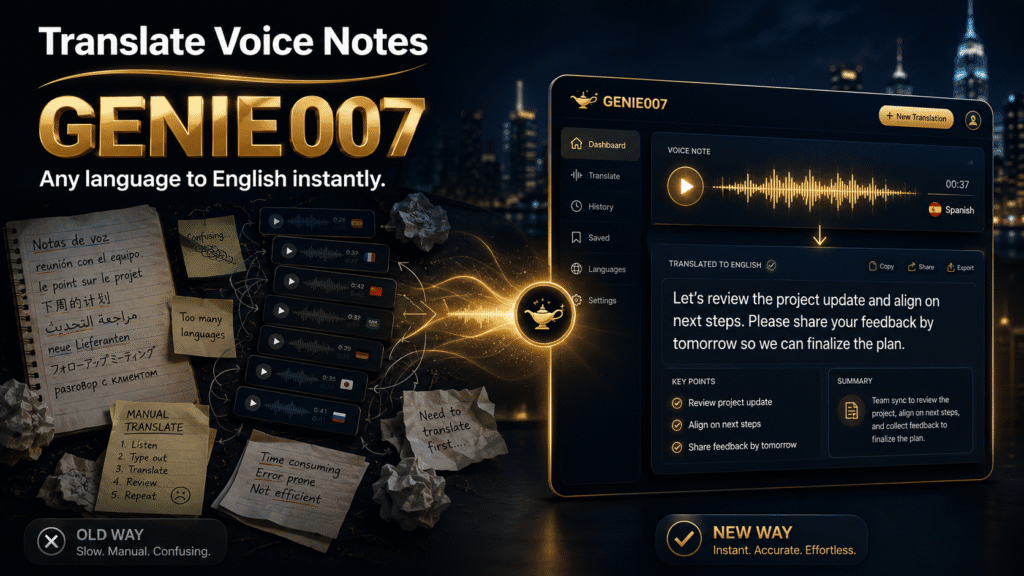
A crisis call comes in; you handle it, then sit down with your supervisor for a debrief. Instead of notes typed in silence later, you dictate together: “Crisis call received 2 pm—client in acute distress, suicidal ideation present, safety plan reviewed and agreed, referred to crisis team, follow-up scheduled 24 hours.” Genie 007’s live translation supports multilingual teams, so if you’re supervising non-native English speakers, they can dictate in their language and output as English notes. The record is complete, the supervision is documented, and there’s no translation burden on the worker.
Workflow 3: Weekly Caseload Review
At your weekly team meeting, you’re reviewing five active cases: progress on each, flags, handovers. Instead of staying late to type, dictate your summaries in the meeting itself: “Maria—progressing on independence goals, attending college three days now, flagged vulnerability in evenings, coordinating with housing.” Your team hears what’s being recorded. Notes land instantly in the system. The meeting ends on time, and the paper trail is complete.
How Much Time Do You Actually Save?
The maths is straightforward. A typical case note takes 12 minutes to type and format; dictation shrinks that to 3 minutes because you’re speaking (faster than typing) and the software handles structure. Across a 25-case caseload with weekly updates, that’s:
- Weekly typing: 25 cases × 12 min = 300 minutes (5 hours)
- Weekly dictation: 25 cases × 3 min = 75 minutes (1.25 hours)
- Weekly savings: 3.75 hours — equivalent to a full morning of client-facing time recovered
- Annual savings: 195 hours (nearly five working weeks per year)
For a team of 10 caseworkers, that’s 1,950 hours annually — enough to hire an additional part-time support worker or restore supervision time. Beyond time, the quality often improves: dictated notes are more conversational and detailed because you’re not constrained by typing speed. Research shows caseworkers make fewer omissions when dictating because speaking captures nuance more naturally than hunt-and-peck typing. This is particularly true for complex cases where emotional tone, relationships, and subtle observations matter as much as the facts.
Addressing Common Concerns
Will Dictation Miss Details or Sound Unprofessional?
Modern voice AI, especially software built on think-to-text technology rather than raw speech-to-text, understands intent and context. When you dictate “Client presented as anxious, fidgeting,” it doesn’t mishear it as “Client presented as ancient, fidgeting.” Genie 007 learns your voice, your client names, and your terminology over time. The output sounds professional because it’s not transcribing your every “um” and pause—it’s interpreting what you mean and delivering polished text. If you want to refine a note, you can edit it in seconds.
What About Client Privacy and GDPR?
This is non-negotiable. Genie 007 processes all voice input on-device (your computer or phone); the audio never travels to external servers. Your dictation stays private—your employer can’t audit it, cloud services can’t access it, and it’s never logged. The software uses AES-256 encryption and has been built to meet GDPR and HIPAA standards. For social workers dealing with child safeguarding data, adult mental health records, or domestic abuse cases, this is essential. Genie 007’s privacy model is designed specifically for regulated professions where client confidentiality is a legal requirement, not a preference.
Is There a Learning Curve?
No. Dictation is intuitive: press record, speak, release. The first note might take 4 minutes instead of 3 because you’re adjusting phrasing, but by the fifth note, most workers dictate faster than they type. Genie 007 runs on Windows, Mac, mobile, and as a browser extension, so it works wherever your case-management system lives—no special setup, no steep training burden. Teams report that caseworkers need less than one day to feel confident. Many caseworkers discover they actually prefer dictation because it mirrors how they think—speaking naturally feels closer to professional conversation than the stilted, abbreviated typing style many people adopt under time pressure. The voice interface also helps you catch your own errors: when you hear your note read aloud (Genie 007 can do this), missing words or phrasing issues jump out immediately.
Making the Transition Smooth
Adopting dictation software for social workers is easiest when you start with one case and build confidence. Set a daily target—dictate notes for three cases tomorrow instead of typing them. Observe how the output differs. Share examples with colleagues who might be sceptical. Most importantly, anchor it to the time saved: if one caseworker recovers 4 hours per week and uses that for supervision, unplanned crises, or even a proper lunch break, the benefit is immediately visible to the team.
Privacy and security fears often evaporate once teams understand that on-device processing means no middleman, no cloud risk, no employer surveillance. For GDPR-regulated work, Genie 007’s approach is actually more protective than cloud-based note-taking tools.
Think-to-Text: The Next Step Beyond Dictation
Traditional speech-to-text transcribes every word you say, including filler words, false starts, and repetitions. You end up editing more than you save time. Genie 007’s think-to-text technology takes a different approach: it listens to your intent and delivers polished output tailored to the context. When writing a case note about a safeguarding concern, think-to-text understands you want a formal, detailed, legally sound record—and structures it accordingly. When dictating a quick handover message to a colleague, it produces something casual and brief. The software adapts to context rather than forcing you to clean up transcripts.
For social workers, this matters enormously. You’re not just transcribing facts; you’re synthesising observations, applying professional judgment, and creating a document that will stand up to scrutiny. Genie 007’s think-to-text approach means your dictations emerge closer to their final form, reducing post-dictation editing and building your confidence faster. Within a week, most caseworkers report that dictating feels more natural than typing when composing case notes.
Frequently Asked Questions
Can dictation software handle specialist social work terminology?
Yes. Genie 007 learns your specific vocabulary—client names, condition names, organisational acronyms, and safeguarding frameworks—as you use it. It’s trained on hundreds of thousands of real-world voice dictations, so it already recognises terms like “attachment disorder,” “risk assessment,” “multi-agency working,” and “strengths-based practice” naturally. If it does mishear something, you can correct it in the text editor, and it learns for next time. Social work has its own language—technical terms mixed with local acronyms specific to your authority or trust—and modern voice AI adapts to this complexity far better than older dictation tools. Within the first two weeks of regular use, Genie 007 will be as familiar with your team’s jargon as you are.
What case-management systems does dictation software integrate with?
Genie 007 works inside virtually any system where you type: Salesforce, Liquid Logic, Mosaic, Carepatron, and any custom or proprietary platform your local authority uses. You’re dictating into the same text fields you’d normally type into, so there’s no integration setup required. It works in email, Google Docs, Microsoft Word, and case-note templates embedded in your organisation’s portal. Unlike specialist social work software that requires vendor integration, Genie 007 works universally at the text-field level. This means rolling it out across your team doesn’t require IT involvement or months of integration testing—caseworkers can download and start dictating immediately into their existing systems.
Can I use dictation software for sensitive or confidential notes?
Absolutely—that’s exactly what it’s designed for. Because Genie 007 processes everything on your device and never sends audio to external servers, sensitive client information stays in your control. No cloud logging, no third-party access, no audit trail of who viewed your recordings. For child safeguarding, domestic abuse, or mental health notes, this privacy model is a major advantage over generic cloud-based transcription services.
Try Genie 007 Free
Reclaim hours from your week by dictating case notes instead of typing them. Genie 007’s think-to-text technology lets you speak naturally, and it delivers structured, professional notes directly into your case-management system—all protected by GDPR-grade privacy and on-device processing.
Download Genie 007 free — available for Windows, Mac, mobile and as a browser extension. No credit card required.
Written by Bill Kiani, founder of Genie 007.